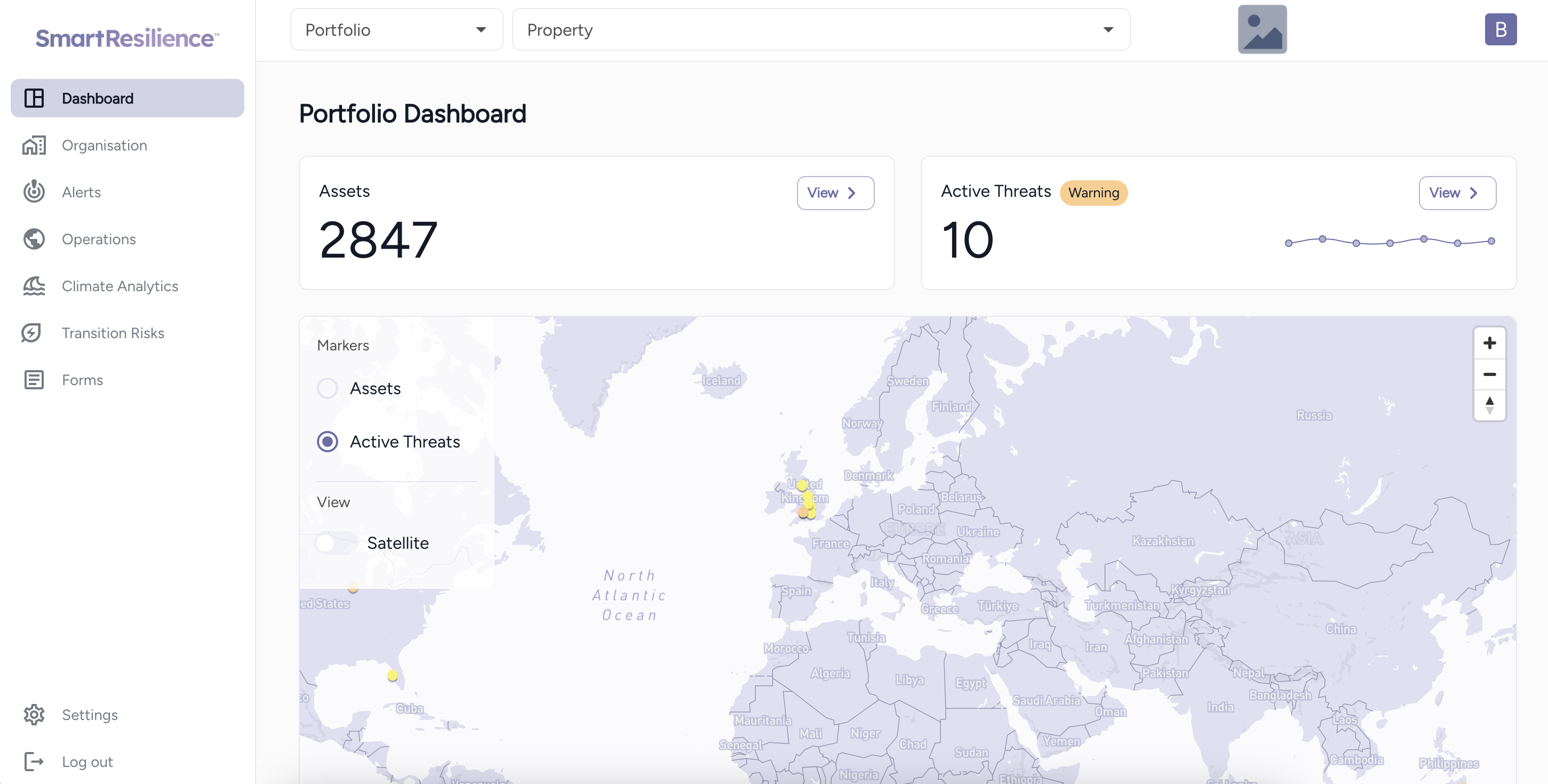
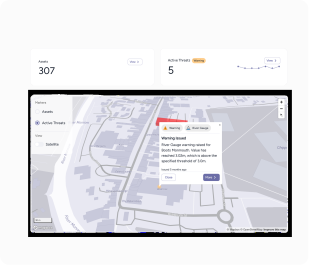
SmartResilience monitors every site in your portfolio continuously, fires a site-specific alert the moment a threshold is crossed, and tells your team exactly what to do next, so that your team prevents damage and disruptions.
SmartResilience sends you a site-specific warning and activates a pre-configured response for your team, so every weather event is handled immediately and documented for insurance purposes.
Each alert reaches the person responsible for that site, with the severity level and context they need to act without waiting for instructions.
Public warnings usually arrive 12 to 24 hours ahead and cover whole areas. Site-specific alerts give your team up to 48 hours to brief staff, move stock, deploy flood barriers and start your response plan, so you avoid the loss instead of cleaning up after it.
48 hours before
Forecast models flag a developing storm, heavy rainfall or high winds at your site.
24 hours
Rainfall forecasts firm up and official agency warnings are issued.
12 hours
Short-range forecasts refine the picture hour by hour.
3 hours
The river gauge that governs your site crosses its threshold and an alert is raised.
Event
See every threat to your sites
We monitor flood, river levels, rainfall, wind, heat, snow and ice, plus official agency warnings, continuously across your portfolio.
Hear only about sites at risk
Thresholds are set for each property and the river gauge that governs it, not a regional average. Your team and ours can adjust them.
Know how urgently to act
Alerts are graded Yellow, Orange and Red, with defined criteria so your team knows what each level means before an alert fires.
Know exactly what to do next
Each alert triggers a response checklist built to your organisation's processes, team roles and the specific site, not a generic industry template.
Prove your response to insurers
Every alert, response and mitigation logged automatically with timestamps. Exportable as PDF for insurers and external auditors.
Act today, plan for decades
Alerts sit on the same site record as your climate risk assessment, so tonight's response and next year's investment use one view.
Public flood and weather warnings cover whole areas. Site-specific monitoring tells you when a specific site is at risk and what to do about it.
| SmartResilience | Public flood and weather warnings | |
|---|---|---|
| Trigger | Get an alert only when your site's river level or weather crosses the limit set for it. | A public warning covers a whole area, so your team has to check which sites are affected. |
| Lead time | Get up to 48 hours' warning, from early forecasts through to live river readings at your site. | A public warning usually comes 12 to 24 hours ahead. |
| Number of alerts | A typical site gets 2 to 3 urgent alerts a year, plus a daily summary of minor ones. | A public warning goes out for every site in the area, so a large estate can get many a day. |
| Response | Each alert goes to the people responsible for that site, with a checklist for your team. | A public warning tells you about the weather but leaves the next steps to you. |
| Evidence | Every alert and action is logged with the time, ready to share with your insurer as a PDF. | A public warning keeps no record of what your team did, so you piece it together at renewal. |
| Long-term view | See each alert alongside the site's long-term climate risk and expected yearly loss. | A public warning says nothing about a site's long-term risk. |
Most clients are onboarded within one to two weeks. We set up the alerts and checklists with your team, then monitor your sites around the clock.
Start today
See how site-specific alerts would work for sites like yours, in a first session built around your portfolio.
Book a session →Set up together
Share your site list and who looks after each site. We pick the sites that need monitoring most and set their alert limits with you.
Plan
We write checklists with your team, so each site knows what to do for every alert.
Relax
Your sites are monitored 24/7, and the right people hear about it when it matters.
What buyers ask us most when they compare early warning options.
We send seven alert types: flood warnings, river gauge levels, rainfall, wind, heat, official agency warnings plus snow and ice. Yellow means minor disruption is possible. Orange means a significant event that calls for caution. Red means high risk that needs action now, for example more than 80 mm of rain in 24 hours or wind gusts above 130 km/h.
You get up to 48 hours of warning. Forecast models flag developing risk 48 to 24 hours ahead, agency warnings usually arrive 24 to 12 hours ahead, short-range forecasts refine it from 12 hours, and river gauges alert live. Agency warnings are sent again 15 minutes before the event starts.
A typical site receives 2 to 3 Orange or Red alerts a year. Only those notify your team, while Yellow conditions go into a daily summary. We set each site's alert thresholds during onboarding, based on the river gauge and weather data that govern it, and your team and ours can adjust them at any time.
We use official warnings from national weather and civil protection agencies in 195 countries, and live readings from around 30,000 river gauges run by more than 40 national hydrological services. Coverage is most detailed in countries with dense monitoring networks. Your own sensors are not connected as standard.
Your team works through checklists written for your organisation, covering flood, imminent storm, during the event and after the event. Every step, incident and mitigation is logged with a timestamp and can be exported as a PDF.
Your team gets Orange and Red alerts by email, by SMS and on the dashboard at the same time, so seeing an alert does not depend on one channel. Several people can follow the same site, for example a site manager and a regional manager, so each alert can reach more than one person. Official agency warnings are also sent again 15 minutes before the event starts.
It does. Your record of alerts, actions and mitigations shows insurers how you manage risk at each site, which gives you evidence to bring to your renewal.
Alerts sit on the same site record as your long-term climate risk analysis, so the operational response and capital decisions are based on one view of each site.
Most clients are onboarded within one to two weeks, starting with their highest-risk sites and adding more over time.
We build a working session around your own sites, so you see what your team would see, and when.
Book a free session