
Compliance officers at mid-size manufacturers have spent the past two years building CSRD (Corporate Sustainability Reporting Directive) reporting processes, only to find in 2026 that the threshold moved. The EU's Omnibus reform now sets mandatory disclosure at more than 1,000 employees and over €450 million turnover, starting with financial years from January 2027, and an estimated 80% of previously in-scope companies fall out of scope. Falling below that line does not remove the underlying obligations: UK carbon budgets, EU Green Deal targets and lender or investor expectations remain in place, and a business that drops out of mandatory CSRD reporting is often still asked for the same numbers voluntarily. That expectation persists because the underlying trend hasn't reversed. The World Meteorological Organization (WMO) recorded 2015 as the first year the globally averaged atmospheric carbon dioxide concentration reached 400 parts per million, and regulatory frameworks have expanded steadily since. The operational logic follows from that: businesses that build compliance into standard practice rather than treating it as a one-off exercise consistently see fewer of the fines, penalties and lost trust that follow when a regulator finds the gaps first. This article explores the importance of regulatory compliance for sustainability, outlining how effective compliance strategies can benefit businesses.
What Is Regulatory Environmental Compliance?
Environmental compliance is the set of laws, monitoring and enforcement mechanisms government agencies use to ensure organisations limit their environmental impact and hold it accountable when it exceeds that limit. It breaks down into three components:
Legal requirements: the specific laws and standards a regulator publishes, which a business can align to before an inspection forces the issue rather than after.
Monitoring and reporting: the systematic collection of compliance data, from figures a business self-reports to third-party inspections and audits.
Enforcement: the fines, remediation orders and corrective actions a regulator imposes once a violation is confirmed.
For a compliance officer building a CSRD, TCFD (Task Force on Climate-related Financial Disclosures) or UK SRS (Sustainability Reporting Standards) disclosure, this is the same framework regulators, lenders and insurers check the final numbers against.
Why does regulatory compliance matter for sustainability strategy?
Regulatory compliance matters because missing it carries the following direct costs:
Fines and remediation orders: the direct cost a regulator imposes for a missed standard, paid regardless of intent.
Higher insurer pricing: insurers price risk more favourably for a business that can show a consistent compliance record rather than a patchy one.
Lender and investor scrutiny: banks and investors increasingly ask for the same disclosure a regulator would require, even once a business falls outside mandatory reporting.
What are the benefits of environmental compliance?
Environmental compliance benefits a business in four ways: lower costs from avoided penalties, a stronger reputation with regulators and customers, less resource waste and more reliable financial reporting. The same logic runs underneath all four: a business that tracks its environmental data consistently, rather than assembling it under pressure before a deadline, spends less time catching problems after the fact and more time acting on them early.
Cost Efficiency: Non-compliance with environmental law carries real financial exposure, not just a theoretical risk. The US Environmental Protection Agency assessed $1.7 billion in civil penalties in fiscal year 2024 alone, and a single case, Cummins Inc.'s $1.675 billion settlement over illegal emissions defeat devices installed on more than 600,000 vehicles, made up most of that total; the EPA calls it the largest civil penalty in Clean Air Act history. A strong Environmental, Health and Safety (EHS) system catches these issues before a regulator does, which is consistently the cheaper outcome.
Reliable Disclosure: Environmental compliance sustainability team a structure framework for tracking and reporting emissions, rather than assembling the numbers from scratch every reporting cycle. That consistence tracking is what a customer, lender or investor checks before taking your sustainability claims at face value.
Lower resource waste: A facilities team that automates the resource and emissions data it already collects for compliance catches a spike, a leak or an inefficient process line, as it happens rather than at quarter-end, while it is still a small problem. The same data set doubles as the evidence a CSRD (Corporate Sustainability Reporting Directive) disclosure or investor questionnaire asks for.
Lower reporting overhead: Feeding that same compliance data into board and investor reporting cuts the time a finance or sustainability team spends reconciling numbers before every disclosure deadline, which is what turns compliance work into cost savings rather than a recurring administrative task.
Practical tip: Run your own numbers before your next audit. A physical risk assessment often flags the same gaps a regulator, lender or insurer is likely to flag. Try the Free Climate Risk Checker to get a first read on your own exposure before it shows up in someone else's report.
What are the main elements of an Environmental Compliance Assurance System?
Environmental compliance assurance, the OECD’s term for how regulators keep businesses within the law, rests on three connected instruments use together:
Compliance promotion: sharing regulatory information, technical assistance and financial incentives that encourage adherence without a penalty attached, the guidance documents and sector helplines a regulator publishes before it ever inspects a site.
Compliance monitoring: the inspections, audits, self-reporting and citizen reporting that generate the evidence enforcement needs to act on, including the figures a business submits between formal audits
Enforcement: the fines, remediation orders and corrective actions a regulator imposes once a violation is confirmed.
These three work together in practice. A regulator uses compliance promotion to target inspections at poorer-performing facilities, and monitoring generates the evidence enforcement acts on. Publishing an enforcement case, in turn, promotes compliance for every other business watching.
How do national and international climate regulations feed into environmental compliance obligations?
International treaties set emissions targets; national law converts them into binding obligations, with their own deadlines and penalties, for a business.
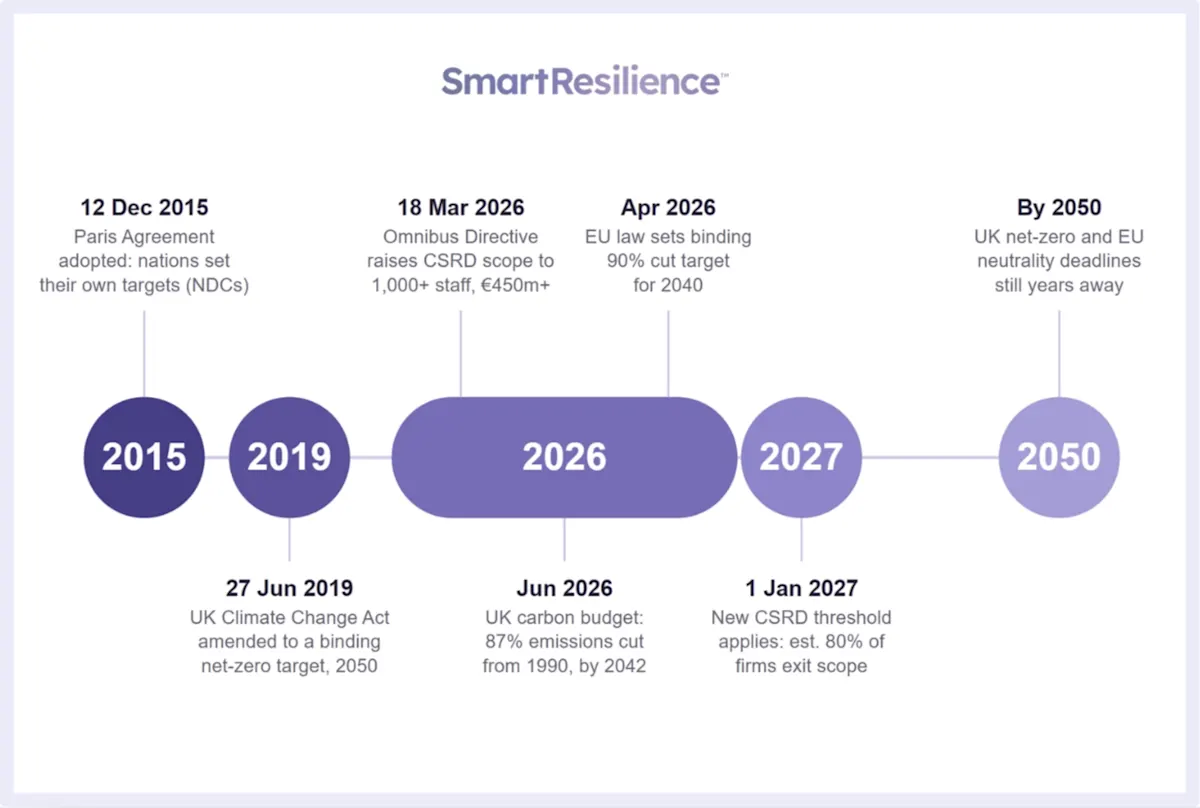
UK 2008 Climate Change Act: legally binding carbon budgets in five-year blocks, currently the Seventh Carbon Budget covering 2038-2042.
EU Green Deal: a 2050 climate-neutrality target with a binding 2040 interim target, and CSRD as its disclosure arm.
Paris Agreement: nationally determined contributions (NDCs) that filter down into domestic law, including both regimes above.
A manufacturer with facilities across the UK and EU has to track both layers, because a national carbon budget miss and an EU Green Deal shortfall carry separate compliance consequences and separate reporting deadlines.
A. The UK Climate Change Act
The UK Climate Change Act 2008 sets legally binding targets for reducing greenhouse gas emissions, and a business's carbon budget planning has to work backward from it. The Act originally targeted an 80% cut by 2050 against 1990 levels; the UK government amended this in 2019 to a net-zero target for the same year.
Parliament agreed the Seventh Carbon Budget (CB7) in June 2026, covering 2038-2042 and targeting an 87% reduction from 1990 levels by 2042. That figure sets the ceiling a facility's emissions baseline needs to track toward now, not at the deadline. If a business hasn't mapped its emissions data against CB7 yet, that's the gap a board asks about before an auditor does.
B. The EU Green Deal
The European Green Deal sets a legally binding path to climate neutrality by 2050. The target that changed most recently sits in between: in 2026 the EU amended the European Climate Law to add a binding interim target of 90% net greenhouse gas reduction from 1990 levels by 2040, on top of the existing 55% cut by 2030.
For a manufacturer, the bigger operational change sits in the Green Deal's disclosure arm, the CSRD. A 2026 Omnibus reform raised the mandatory reporting threshold to companies with more than 1,000 employees and over €450 million in turnover, effective for financial years starting January 1 2027, removing an estimated 80% of previously in-scope companies from mandatory reporting. A business that drops below that threshold often still faces the same disclosure expectation voluntarily from lenders and investors, so the CSRD status worth checking is against the new numbers, not the old 250-employee line.
A manufacturer importing into the EU also sits inside CBAM, the Green Deal's border-carbon mechanism. Its definitive phase began on January 1 2026: imports of covered goods now require verified, installation-level emissions data from suppliers, or a default benchmark value applies at a cost disadvantage. Certificate purchases start in 2027 against 2026 import volumes, priced against EU Emissions Trading System auction averages, with a €100-per-tonne penalty for a shortfall, a cost line that belongs in a 2026 capital plan even though the cash outlay lands the following year.
C. The Paris Agreement
Countries adopted the Paris Agreement in 2015 as a legally binding international treaty that commits participating countries to their own NDCs and to limiting global warming to well below 2°C, with efforts toward 1.5°C.
The treaty's membership shifted in 2026: the United States' withdrawal took effect on January 27 2026, bringing the number of Parties to 194. That withdrawal changes US federal policy, but it doesn't change obligations under UK or EU law. A manufacturer with European operations still has to meet Climate Change Act and CSRD deadlines regardless of US policy direction.
Practical tip: Not sure whether the new CSRD threshold takes you out of scope? Request a demo to walk through whether your organisation sits against the 1000-employee/€450m turnover line, and see how SmartResilience produces audit-ready CSRD disclosures if you’re still in.
What strategies can be implemented to ensure Environmental Regulatory Compliance?
Organisations can effectively manage their environmental responsibilities, reduce risks, and showcase their commitment to sustainability by following the steps below:
1. Determine compliance obligations: Identify the legal, national and international regulatory standards that apply to each site.
2. Check what actually applies: Confirm which regulations bind a specific site, product line or market, so the compliance team spends effort on what is pertinent rather than every regulation in the sector.
3. Translate obligations into internal policy: Turn each legal requirement into a specific process a facilities or operations team can follow, with clear ownership.
4. Monitor and communicate: Audit compliance status on a set schedule and report findings to the board in the same financial language finance already uses, not a standalone sustainability update.
5. Track regulatory change: Revisit the mapping whenever a regulator moves a standard, the way the 2026 CSRD threshold change or the Seventh Carbon Budget just did.
How SmartResilience helps you turn CSRD and climate compliance into audit-ready disclosures?
You've mapped your obligations against the relevant CSRD requirements, carbon budgets and climate regulations. Now you need to produce clear, audit-ready disclosures that your board, insurers, lenders and external auditors can trust, without rebuilding your reports every time the underlying data changes.
SmartResilience Climate Assessments turn that mapping into an audit-ready output detailing:
Site-level quantification: financial exposure calculated per site, not aggregated at portfolio level where individual gaps disappear.
Disclosure-ready formatting: output structured to CSRD, TCFD, International Financial Reporting Standards Climate-related Disclosures (IFRS S2) and UK SRS requirements directly, with data lineage a compliance team can walk an auditor through.
ROI-ranked adaptation measures: every flagged risk paired with a costed action, so a board sees what to do next, not just the exposure.
Continuous updates: the assessment updates as portfolios and regulatory thresholds change, instead of ageing the day it's delivered.
A FTSE 100 client came to SmartResilience after a "black box" consultancy report failed to deliver TCFD-aligned, EU-regulation-ready climate reporting across its operations in 50 countries. Working with SmartResilience, the client strengthened its TCFD reporting capability and cut climate analysis costs by 50%, evidence a board and an external auditor both find credible.
Regulatory compliance is no longer optional: it is a strategic imperative for sustainable business success. By building resilience together, we can address these regulatory challenges brought about by climate-related risks. Contact us today to embark on a journey towards a sustainable future.
Frequently Asked Questions (FAQs)
Does the new CSRD threshold apply to reports you've already filed, or only future filings?
The threshold change takes effect for financial years starting January 1 2027, so reports already filed under the old rules stand. A business that falls out of scope stops mandatory reporting from that financial year, not retroactively. Confirm your specific filing year with legal counsel before assuming a prior obligation applies.
If a company drops below the CSRD threshold, do TCFD and UK SRS obligations disappear too?
No. CSRD, TCFD and UK SRS are separate regimes with different scope tests. A business can fall out of mandatory CSRD reporting while still being required, or expected, to report under TCFD or UK SRS depending on its listing status, sector or lender requirements.
Who actually enforces CSRD, TCFD or UK SRS compliance, and what happens if a company misreports?
Enforcement sits with each country's national regulator rather than one central climate authority: EU member states enforce CSRD through their own competent authorities, and the UK enforces its frameworks separately. Consequences for misreporting typically include corrective disclosure orders, financial penalties and, in some jurisdictions, director liability for false statements.
How often should a business expect carbon budgets or CSRD thresholds to change?
Carbon budgets are set in five-year blocks under the Climate Change Act, with the next update due when CB7 concludes in 2042. CSRD's scope has already changed once via the 2026 Omnibus reform, so treating the current threshold as permanent rather than reviewing it periodically is a planning risk.