A climate risk assessment built around one expected future looks solid, right up until a flood, a storm or a carbon price shock arrives that wasn't the one modelled. That's the gap scenario analysis exists to close: not a better forecast, but a deliberate test of a strategy against several different futures instead of one.
The Task Force on Climate-related Financial Disclosures (TCFD) lists scenario analysis as a core recommendation for exactly this reason, and the record so far is not reassuring. When the Bank of England ran this test on the UK's largest banks and insurers in 2021, most still couldn't model their own climate exposure with confidence. The same expectation now applies to any large asset owner reporting under TCFD, Corporate Sustainability Reporting Directive (CSRD) or UK Sustainability Reporting Standards (SRS), not just banks.
What is scenario analysis?
Scenario analysis is a method for testing a strategy against several different, internally consistent futures, rather than forecasting the single future thought most likely. A scenario is not a prediction: it deliberately describes one plausible path a set of conditions could take, so a business can pressure-test its plans against a range of outcomes instead of just one. Applied to climate change, this means asking how a portfolio performs under a low-warming future and a high-warming future side by side, then building a strategy resilient to both rather than optimised for only one.
Physical risk scenarios model what happens to assets and operations as extreme weather events become more frequent and severe under higher warming, floods, heatwaves and storms among them.
Transition risk scenarios model what happens as policy, carbon pricing and technology shift to bring emissions down, the costs and disruptions of the low-carbon transition itself.
The Intergovernmental Panel on Climate Change (IPCC) formalised this with its Representative Concentration Pathways (RCP) in 2014: RCP 1.9, the pathway consistent with the Paris Agreement's 1.5°C goal, sits at one end, and RCP 8.5, a warming of roughly 4.3°C by 2100, sits at the other. A portfolio that only ever gets modelled against one of these two extremes is missing half the picture, since the physical risk and the transition risk move in opposite direction
How does a business actually conduct a scenario analysis?
TCFD's own guidance breaks the process into six steps, though the specifics are unique to each organisation: the sector, the geography of its sites, its supply chain and its stakeholders all change which scenarios matter.
Ensure Governance: Organisations should incorporate scenario analysis into the strategic decision-making process by involving key internal and external stakeholders.
Assess Materiality of Climate Risks: Companies have to conduct materiality assessments related to climate risks. For instance, companies have to determine the important factors associated with the operation and financial functions. Organisations also have to discover what physical and transition risks affect their overall business operations. Moreover, businesses shall have to consider technological and legal considerations relevant to their organisation.
Identify and Define a Range of Scenarios: In this step, companies will determine all possible climate events that can happen. This will include risks and opportunities related to transition risks, such as a carbon tax, and physical risks, such as probable damage by hurricanes and floods.
Evaluate Business Impacts: Now organisations will assess the potential effects on the business by evaluating how different scenarios may influence operational expenses, regulatory compliance costs, supply chain dynamics, and the risk of interruptions to business activities.
Explore Possible Responses: These may involve investing in new technologies, adjusting business models and processes, and diversifying investments in portfolios.
Document and Disclose: In the last step, it is essential for businesses to thoroughly document the scenario analysis process and transparently share these findings in their annual sustainability reports.
What is climate stress testing?
A climate stress test applies the logic of financial stress testing, in place since the 2008 crisis, to climate change: instead of an economic shock, it tests exposure to a specific warming or transition pathway, then asks what breaks. That logic began with the Federal Reserve and the European Central Bank requiring banks to prove they could survive a severe economic shock, not just an average one.
This started as a regulatory exercise for banks, but it hasn't stayed one. The Federal Reserve's 2023 pilot climate scenario exercise ran six of the largest US banks (Bank of America, Citigroup, Goldman Sachs, JPMorgan Chase, Morgan Stanley and Wells Fargo) through a physical risk module testing their real estate loan portfolios, and found the same data gaps and modelling inconsistencies the Bank of England had found two years earlier. Since then, the expectation has moved from bank balance sheets to any large asset owner's own physical portfolio, since the same question, "what happens to this portfolio under a specific climate pathway", is exactly what TCFD and CSRD scenario disclosures ask a business to answer for itself.
The Network for Greening the Financial System (NGFS) now publishes a standard set of reference scenarios, grouped into orderly transition, disorderly transition and hot house world pathways, so that a stress test run by a bank, a regulator or a corporate portfolio can be compared on the same terms rather than each inventing its own.
Top-down or bottom-up: which approach fits a multi-site portfolio?
Most large portfolios need both: a top-down pass to find where exposure is concentrated, then a bottom-up analysis on the highest-risk sites to get numbers a board or auditor will actually trust.
Approach | Method | Trade-off |
|---|---|---|
Top-down | A single set of scenarios applied consistently across every site or asset, using external data rather than each site's own numbers | Fast and comparable across a whole portfolio, but misses what makes any one site different |
Bottom-up | Each site or division runs the scenario against its own operational and hazard data, then results are aggregated | Takes more effort, but surfaces specific vulnerabilities a generic top-down pass would smooth over |
Site-level or portfolio-level: what should the analysis cover?
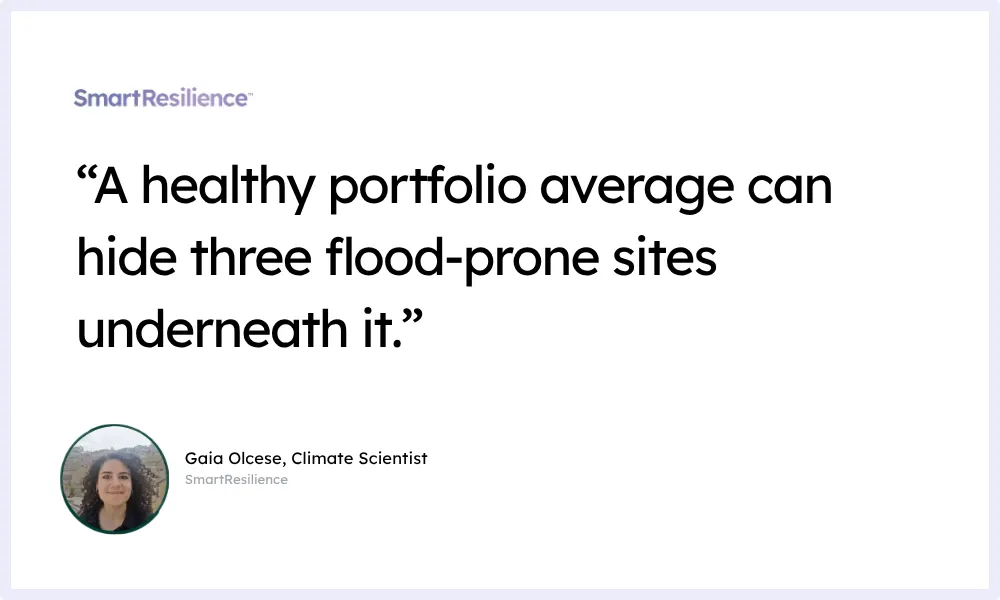
Both levels are usually needed, not one instead of the other: a business running only portfolio-level analysis can tell a board its overall exposure is manageable while missing that three sites in the same flood plain account for most of it.
Analysis level | Focus | Purpose |
|---|---|---|
Site-level | An individual asset's exposure geography, sector, and adaptation measures | Informs decisions specific to that site |
Portfolio-level | Every asset aggregated into a single view | Shows leadership where risk concentrates across the whole estate, rather than one building at a time |
What time horizon should a scenario analysis use?
Most organisations run both: the short-term horizon to justify this year's adaptation spend, the long-term horizon to check that spend is still pointed the right way a decade from now.
Time horizon | Range | Primary use | Key considerations |
|---|---|---|---|
Short-term | 2 to 5 years | Capital and strategic planning; the default for financial institutions and asset owners | Directly actionable within the current budget cycle |
Long-term | typically to 2050 or beyond | Aligning strategy with commitments like the Paris Agreement's well-below-2°C goal; positions the organisation ahead of gradual environment shifts | Prioritises long-term resilience over immediate budget allocation, ensuring today's spend remains sound a decade from now |
Practical tip: Not sure whether your portfolio has ever been scenario-tested at site level, rather than just modelled as a single average? Try the Free Climate Risk Checker for a first read, then request a demo to see how SmartResilience runs the full scenario analysis site by site.
How does SmartResilience turn scenario analysis into a live capability?
A scenario analysis that lives in a PDF from last year's reporting cycle is already out of date the moment a regulator, a carbon price or a site's own risk profile shifts. SmartResilience Climate Assessments run scenario modelling as a continuously updated capability rather than a one-off report:
Site and portfolio-level modelling together: the same platform runs both levels of analysis, so a board sees the aggregate exposure and a facilities team sees what it means for their specific site.
Multiple pathways, not one: exposure is modelled against several warming and transition scenarios in parallel, so a strategy gets tested against a range rather than a single assumed future.
ROI-ranked adaptation measures: every flagged vulnerability is paired with a costed response, so a board sees what to do about the exposure, not just its size.
Continuous updates: the model updates as sites, portfolios and climate data change, rather than ageing the day it's delivered.
Sainsbury's runs this across more than 1,000 sites and used site-level scenario modelling to identify and act on a flood exposure that avoided an estimated £3 million in damage, evidence that scenario analysis pays for itself well before the next disclosure deadline.
Working with SmartResilience means scenario analysis stops being a report a team rebuilds every year and starts being a live view of where the portfolio is actually exposed.
The organisations that treat scenario analysis as a live, site-level practice are the ones with an answer ready the next time a regulator, an insurer or an investor asks for one.
Request a demo to see how SmartResilience runs site and portfolio-level scenario analysis on your own asset data.
Frequently Asked Questions (FAQs)
Is scenario analysis the same as a weather forecast?
No. A forecast predicts the most likely near-term outcome. Scenario analysis deliberately tests a strategy against several different, internally consistent futures, including ones considered less likely, so a business understands its resilience across a range rather than betting on one prediction.
Does a business need to run its own climate stress test, or is that only for banks?
Stress testing began as a bank regulatory exercise, but TCFD and CSRD now expect any large asset owner to show the same discipline applied to its own physical portfolio, not just financial institutions holding climate-exposed loans.
How many climate scenarios does TCFD actually expect a business to test?
TCFD does not fix an exact number, but its guidance specifically expects at least one scenario aligned with a 2°C or lower warming pathway, tested alongside a higher-warming pathway, so the comparison itself is meaningful.
How often should a scenario analysis be repeated?
At minimum whenever a material change occurs, a new site, a shifted regulatory threshold, an updated climate dataset, rather than only at the next scheduled reporting cycle. A static analysis is already stale before the following year's report is due.