Buying climate risk software usually starts one of two ways: a weather event just cost you money and you're determined it won't happen again, or a compliance deadline has landed the decision on your desk. Most vendor conversations - and most buyer's guides - get lost in model resolution, scenario counts and hazard lists. Those details matter less than a simpler test: will this platform change what your team does when a flood, heatwave or storm is heading for one of your sites?
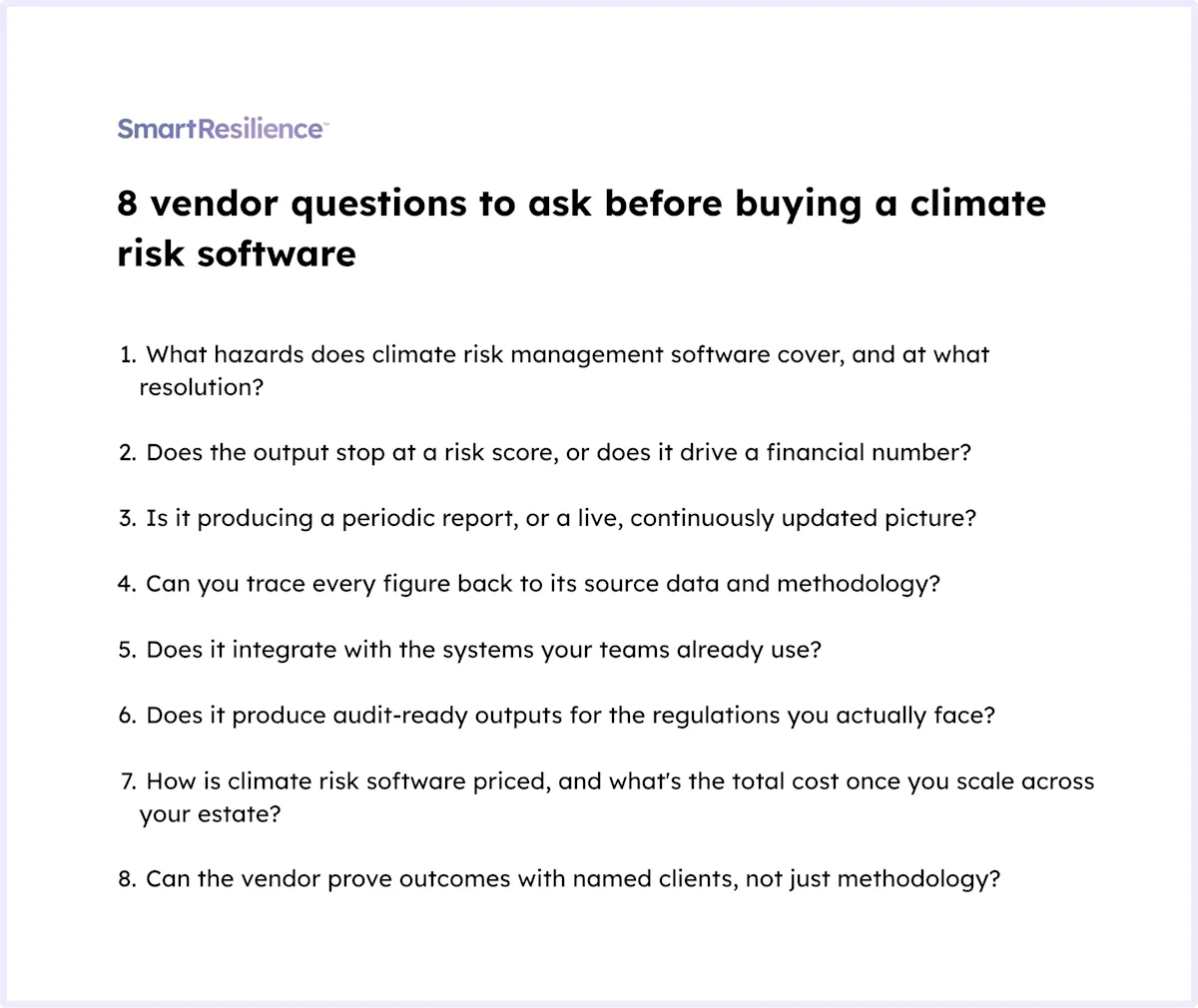
We outlined eight questions to ask to ensure you select a climate risk solution suitable for your organization - whether you're preparing for a vendor call, or an RFP.
What hazards does climate risk management software cover, and at what resolution?
Any credible platform should cover acute hazards alongside chronic risks, and it should calculate exposure at the level of an individual site rather than averaging across a postcode or region. A regional average tells you almost nothing about whether your warehouse in a specific flood plain is exposed.
Look for:
Acute hazard coverage: flooding, wildfire, tropical storms and high winds
Chronic hazard coverage: sea-level rise, drought and rising average temperatures
Site-level resolution: exposure calculated by address or coordinates, not by postcode or region
Honest roadmap labelling: a clear distinction between hazards modelled today and hazards planned for a future release
This question is table stakes rather than a genuine point of difference between vendors. Nearly every credible platform in this category covers the major hazards at reasonable resolution, so use the answer to rule providers out rather than to pick a winner.
Does the output stop at a risk score, or does it drive a financial number?
Good climate risk software converts hazard exposure into a financial figure at site level, such as an annualised average loss or the estimated cost of a 1-in-100-year event, rather than stopping at a risk score or a coloured map. A score tells you that a site is exposed. It does not tell you what that exposure will cost your business if the event happens.
What good looks like:
An annualised average loss figure, calculated per site
The estimated cost of a specific event, such as a 1-in-100-year flood
A worked example using one of your own sites, not a generic template
A way to compare exposure across sites, so you can prioritise where to invest first
This distinction separates two categories of tool. Some platforms stop at hazard scoring and scenario analysis, which is useful for disclosure but limited for operational decision-making. If a vendor cannot show you a worked example of a hazard translating into a pound or dollar figure for a specific site, treat that as a gap, not a detail to sort out later.
Is it producing a periodic report, or a live, continuously updated picture?
One of the clearest ways to separate a static consultancy deliverable from an operational tool is whether it monitors conditions continuously and updates as your portfolio and the climate science change, rather than delivering a fixed assessment on an annual or one-off cycle. A platform stuck on a fixed cycle can only tell you what your exposure looked like last year, not what it looks like this week. Questions to ask directly:
Is this a fixed-cycle assessment refreshed annually, or continuous monitoring updated in real time?
Do alerts fire ahead of a forecast event, rather than a report landing after the fact?
Does the output update automatically as sites are added to or removed from the portfolio?
Sainsbury's used a live, site-specific early warning system across more than 1,000 sites and avoided a £3m flood damage event that a fixed annual report would not have caught in time. A periodic assessment is still useful for understanding long-term exposure and for regulatory disclosure, but it cannot warn a site manager that a flood is approaching this week. Read the Sainsbury's flood risk case study for the full detail on how site-specific alerting worked in practice.
Can you trace every figure back to its source data and methodology?
A platform with genuine data lineage can show exactly how it calculates a specific number, such as a site's annualised loss estimate, from the raw hazard data through to the final figure. That transparency gives you something you can defend to an auditor, an insurer or a board.Push for, in the demo itself:
A live walkthrough of how one specific figure was calculated, from raw data to final output
Named data sources and modelling assumptions behind that figure
Documentation detailed enough to cite directly in an audit or investor review
Peer-reviewed or externally validated methodology, not an internal model taken on trust
This question matters most to organisations that have previously worked with black-box modelling and struggled to explain or defend the results internally. A vendor's ability to answer this live tells you more than any documentation they send afterward.
Does it integrate with the systems your teams already use?
Genuine integration means an alert becomes a task someone at the affected site is actually assigned to complete, not just a data feed connected to your enterprise resource planning (ERP), geographic information system (GIS) or facilities management systems. Integration that stops at a data feed is not the same as integration that changes a workflow.
What genuine integration looks like:
Connections to your existing ERP, GIS or facilities management systems
The path from an alert to a task, including who at the site is assigned to act
The exact screen or notification a site manager sees, not just the dashboard an analyst uses
Role-based access so a facilities manager, a sustainability lead and a finance director each see what is relevant to them
A platform can pull in dozens of data sources and still fail this test if an alert lands in an inbox nobody checks. If a vendor cannot describe the handoff from alert to action clearly, the integration is technical rather than operational.
Does it produce audit-ready outputs for the regulations you actually face?
A platform is only as "compliance-ready" as the specific framework it has been built to satisfy, and that framework needs to match the one your organisation actually reports against. A platform aligned to TCFD (Task Force on Climate-related Financial Disclosures) will not automatically satisfy CSRD (the EU Corporate Sustainability Reporting Directive), which asks for more granular, audited disclosure.
Confirm, framework by framework, whether the platform supports the frameworks you're up against, such as:
TCFD, for scenario-based physical and transition risk disclosure
CSRD, for the EU's more granular, audited sustainability reporting
UK SRS (UK Sustainability Reporting Standards), for UK-headquartered businesses
IFRS S2 and ASRS (Australian Sustainability Reporting Standards)
Ask a vendor to name the frameworks they support rather than accepting a general climate disclosure claim.
If you want to see how UK climate reporitng requirements are shifting, read our TCFD to UK SRS S2 guide for 2027.
How is climate risk software priced, and what's the total cost once you scale across your estate?
Vendors usually structure pricing per site, per user or per hazard, and the total cost can shift sharply once you scale from a pilot to a full estate. This is one of the most commonly skipped questions in vendor conversations, and one of the most expensive to get wrong after signing a contract.
Get clear, written answers on:
Whether pricing is structured per site, per user or per hazard
Whether cost changes when you add a site mid-contract
Whether cost changes when you remove a site, and whether the contract allows it
Whether additional hazards or users carry separate charges
A pricing model that looks affordable for a pilot of 20 sites can scale unpredictably once you roll it out across an estate of several hundred. Get this in writing before you commit, not as a verbal assurance in a sales call. Can the vendor prove outcomes with named clients, not just methodology?
Can the vendor prove outcomes with named clients, not just methodology?
A vendor with genuine operational deployments can point to a real organisation and a real number. Ask for named clients and specific, verifiable outcomes directly, and treat a vague answer as a warning sign.
What proof should include:
A named client in a comparable sector or estate size
A specific, verifiable outcome, financial or operational
A reference you can speak to directly, not a quote pulled from marketing material
If a vendor's answer stays at the level of methodology or model accuracy without ever naming a customer or a result, that gap is worth noticing.
This is also the point in the evaluation where the outputs need to work for more than one audience.
How does SmartResilience answer these questions?
SmartResilience was built around the belief that a climate risk platform should change what happens at a site, not just produce a better version of the same report.In practice, that means:
Live, site-specific alerts calibrated against historical events, not generic regional warnings
Financial exposure quantified at site level, updated continuously rather than on a fixed cycle
Transparent data lineage, so a sustainability team, a finance director and a facilities manager can each trace and trust the same number
Using SmartResilience, Sainsbury's avoided a £3m flood damage event across more than 1,000 sites, and G1 Automotive brought flood risk under control across 150 sites. Neither team got there from a more detailed report. Both got there from a platform embedded in how their teams already work.
The next weather event that matters to your business is either the one you have already had, or the one still ahead of you. Either way, the eight questions above give you a way to find out, in a vendor conversation, which platforms are built to change what happens on the ground and which ones will hand you a better-looking report and stop there.
If you manage sites across a portfolio and want to see how these questions apply to your specific exposure, request a demo and we will walk through your actual hazard data, not a generic example.