
Every business we speak to has assessed its climate risk at least once. Almost none have built an ongoing framework to manage transition risk: exposure to policy change, new technology, market shifts and reputational scrutiny, across every division and geography they operate in. A Chief Sustainability Officer at a multinational usually discovers the gap when group finance asks for one consistent transition risk figure and each division has assessed exposure differently, if at all. Building a transition risk management framework is what closes that gap, not another one-off assessment.
What is a transition risk management framework, and why do most companies not have one?
A transition risk management framework is the ongoing process a business uses to identify, quantify and govern its exposure to the low-carbon transition, instead of relying on a single assessment that goes stale within a year. It exists because policy, technology, market and reputational pressures shift faster than an annual report can track. How physical risk differs from transition risk is worth understanding first, since the two are governed in different ways from the outset.
Transition risk can be broken down into four drivers:
Policy and legal risk: the cost of new regulation, carbon pricing and climate litigation.
Technology risk: the cost of adopting new low-carbon technology, or of being left behind by competitors who adopt it first.
Market risk: the cost of demand shifting away from fossil-fuel-dependent products, and of rising input costs as supply chains decarbonise.
Reputation risk: the cost of how investors, lenders and customers judge a company's transition record.
Who should own transition risk inside a multi-divisional business?
Transition risk needs a named owner spanning sustainability, finance and operations, not a single function holding it alone. Sustainability teams are usually the ones who start the work, but they rarely control the budget or the assets that transition risk actually affects.
Four functions typically need to be involved, each for a different reason:
Sustainability: starts the work, tracking regulatory change and running the initial exposure assessment.
Finance: translates exposure into numbers a CFO will act on, revenue at risk, capital that could be stranded, cost of capital under different transition scenarios.
Divisions and operations: act on what the assessment finds, switching suppliers, retiring assets earlier than planned, or building new capital expenditure into the roadmap.
Procurement: owns the supply chain exposure that sustainability alone cannot see clearly across dozens of markets.
A structure that holds up in practice is a small cross-functional steering group, sustainability, finance and one divisional operations lead, meeting on a fixed cadence to review exposure and sign off on what changes. This does not need to be a large committee. It needs enough functional coverage that no single team can block or ignore a finding once it is raised.
Practical tip: If transition risk sits with sustainability alone, treat that as a warning sign rather than a norm. An assessment with no budget owner and no divisional owner rarely survives past its first report.
How do you map and prioritise transition risk exposure across divisions and geographies?
Mapping transition risk exposure starts with an inventory of which teams, across which division and geography, carry responsibility for which driver, rather than applying one national or group-wide model everywhere.
Map by division, not by group average
Teams running a food manufacturing division often carry responsibility for market and reputation risk, tied to packaging and ingredient sourcing, more than policy risk. Teams running an energy-intensive plant often carry responsibility for policy and carbon-pricing risk more than market risk. Treating both the same way produces a group-level number that hides where the real exposure sits.
Account for uneven data quality
Data quality is rarely consistent across this exercise. Energy use, carbon intensity and capital plans are usually well documented in mature markets, and thin or inconsistent in markets across Asia and Latin America where reporting infrastructure is newer. Building the map with that gap acknowledged, rather than assumed away, keeps the resulting exposure figures credible when finance and auditors start asking questions.
Key takeaway: A transition risk map that treats every division identically will understate exposure somewhere and overstate it elsewhere, and either error becomes visible the first time a division is asked to defend its number.
How do you decide between centralised and divisional governance?
The right balance centralises the taxonomy and reporting standard while leaving divisions free to act on their own exposure, rather than choosing one extreme.
Use centralised governance for:
One shared definition of what counts as material transition risk, agreed at group level rather than left to each division.
One reporting format, so finance can add every division's number together into a single group figure instead of reconciling formats by hand.
One set of scenario assumptions, so results stay comparable across divisions instead of each one running its own view of the future.
Use divisional governance for:
Retiring an asset earlier than originally planned.
Switching a supplier whose product is exposed to carbon pricing.
Redesigning a product line to reduce market or reputation risk.
Only the team on the ground has the operational context to make those calls well, the same way only the group can keep the numbers comparable enough to add together.
Get this split wrong and divisions build methodologies finance cannot add together at reporting time. The fix becomes a costly rebuild, re-running models, reconciling categories and re-briefing auditors, that repeats every cycle instead of happening once.
How can SmartResilience help you build a transition risk management framework?
SmartResilience helps by putting the physical risk half of the framework on solid, audit-ready footing, so the governance discipline your transition risk work needs already has a working example to copy. CSRD and IFRS S2 both expect the two halves, known together as double materiality, to be produced under one consistent, auditable methodology rather than as two unrelated projects.
Physical risk work stays current through three disciplines a transition risk framework needs to borrow to survive past its first assessment:
Continuous monitoring, rather than a single point-in-time assessment.
One taxonomy across every division, so results can be compared and added together.
Audit-ready evidence, instead of black-box output an auditor cannot verify.
SmartResilience's double materiality approach to CSRD reporting covers how to structure that combined disclosure in detail.
What should you do in the next quarter to start building this?
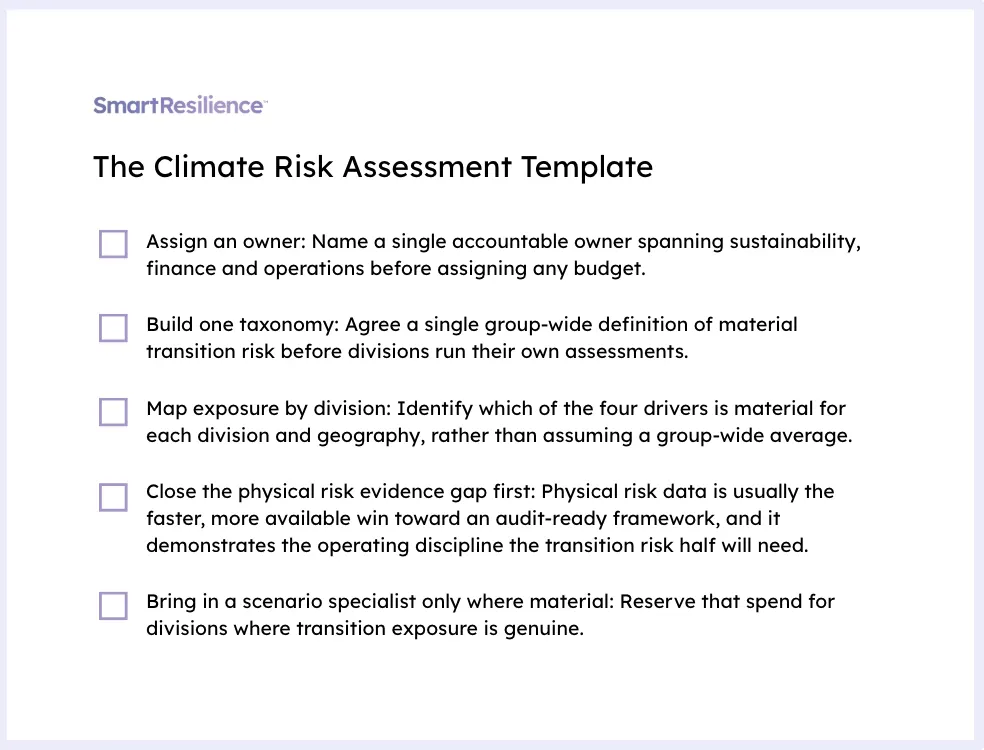
Start by naming an owner, then work through the sequence below. The Climate Risk Assessment Template below can structure the physical risk portion of the exercise while the transition risk taxonomy is still being agreed elsewhere in the business.
Assign an owner: Name a single accountable owner spanning sustainability, finance and operations before assigning any budget.
Build one taxonomy: Agree a single group-wide definition of material transition risk before divisions run their own assessments.
Map exposure by division: Identify which of the four drivers is material for each division and geography, rather than assuming a group-wide average.
Close the physical risk evidence gap first: Physical risk data is usually the faster, more available win toward an audit-ready framework, and it demonstrates the operating discipline the transition risk half will need.
Bring in a scenario specialist only where material: Reserve that spend for divisions where transition exposure is genuine.
The next divisional reorganisation, market entry or reporting cycle will test whether this framework holds up under change, not whether the first assessment was thorough. Building the governance now, starting with the physical risk evidence that is fastest to make audit-ready, is what determines whether transition risk becomes a live capability or another report that goes stale within a year.
Request a demo to see how SmartResilience applies the same continuous, audit-ready operating discipline to physical risk, the model a transition risk framework can build on when finance and divisions ask for one consistent number.
Frequently asked questions - FAQs
What is a transition risk management framework?
An ongoing process for identifying, quantifying and governing a company's exposure to the low-carbon transition, covering policy, technology, market and reputation risk. It replaces a one-off assessment with a live view that updates as regulation, markets and technology change.
What are the four main drivers of transition risk?
Policy and legal risk, technology risk, market risk and reputation risk. Each covers a different source of financial exposure as the economy moves away from fossil fuels, from new regulation and carbon pricing to shifting consumer demand.
Who owns transition risk in a company?
No single function should own it alone. Sustainability usually starts the assessment, finance translates it into figures the business acts on and divisions and procurement act on what the assessment finds.
Do you need a separate platform for transition risk?
Only where exposure is material. Scenario analysis for material transition exposure requires specialist financial modelling that most sustainability teams do not have in-house, and that most physical risk platforms, including SmartResilience's, do not provide.
How does transition risk relate to double materiality?
CSRD and IFRS S2 both require double materiality disclosures covering physical and transition risk together. A transition risk framework produces the transition half, a physical risk programme produces the other and both need to be internally consistent.
What happens if you delay building a transition risk framework?
Each reporting cycle without one means re-doing the mapping exercise from scratch, and the group figure finance receives becomes harder to defend every time a division changes its own approach independently of the others.