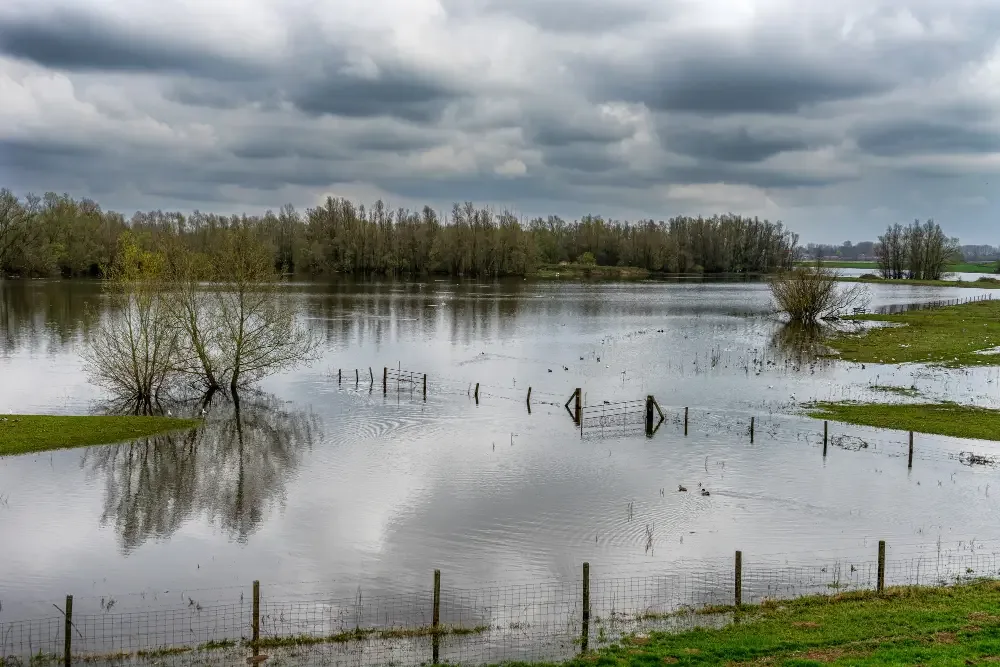
A store manager reports a flooded stockroom, a physical risk that facilities logs, repairs and moves past. In the same reporting cycle, someone in finance is asked to explain the business's transition risk exposure to rising carbon costs. Both get filed under climate risk, even though they're answered by different teams using different data. Only one of them is something a site team can act on this week.
What's the difference between physical and transition risk?
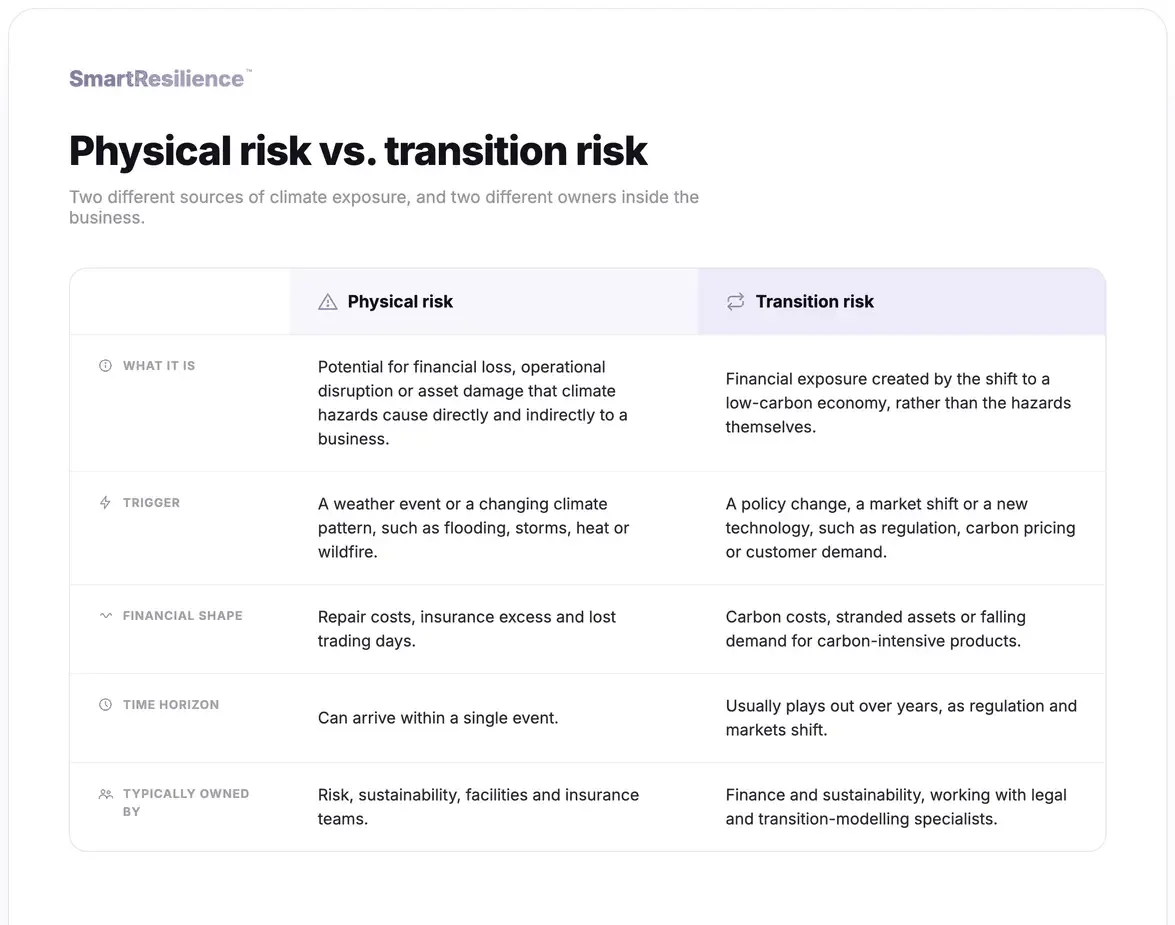
The difference between physical and transition risk is what causes each one: physical risk comes from climate hazards themselves, such as flooding, storms, heat and wildfire, while transition risk comes from the shift to a low-carbon economy, such as changing regulation, carbon pricing and shifting customer demand. Physical risk causes direct and indirect financial loss, operational disruption or asset damage. Transition risk causes financial exposure rather than physical damage.
That difference plays out in three ways:
A different trigger: physical risk starts with a weather event or a changing climate pattern, while transition risk starts with a policy change, a market shift or a new technology.
A different financial impact: physical risk shows up as repair costs, insurance excess and lost trading days, while transition risk shows up as carbon costs, stranded assets or falling demand for carbon-intensive products.
A different time horizon: physical risk can arrive within a single event, while transition risk usually plays out over years as regulation and markets shift.
See the table for the full breakdown:
Why do physical and transition risk usually end up with different owners?
Physical risk and transition risk usually end up with different owners because each one shows up somewhere different first: physical risk on a site, and transition risk in a cost line, a supplier contract or a disclosure requirement. A facilities manager, a property team or an operations lead is usually the first to see physical risk, since they already know which sites flood or lose power in a storm. Finance, procurement or the sustainability reporting team is usually the first to see transition risk, since it arrives as a policy change or a pricing shift rather than a site-level incident.
In practice, that means:
A facilities or operations team can act on physical risk directly by hardening a site, changing a delivery schedule or renegotiating insurance cover, often without waiting on a group-wide decision.
Finance and procurement usually need to act on transition risk collectively, since it touches pricing, supplier contracts and reporting commitments across the business rather than one site.
Neither risk gets addressed well when it defaults to whichever team already holds "climate risk" on their job title, since a compliance officer with no site-level visibility cannot act on a flood risk any more than a facilities manager can renegotiate a supply contract.
What does physical risk actually look like day to day?
Physical risk shows up day to day in two forms: acute risk from a sudden, discrete event and chronic risk from gradual, long-term change. Knowing how to assess physical risk starts with identifying which of these two categories a given site's exposure falls into:
Acute risk: a flood, storm or heatwave that closes a site, damages stock and triggers an insurance claim tied to a single date.
Chronic risk: gradual shifts such as rising average temperatures, water stress or sea-level rise, which push up costs over time, cooling, water and insurance among them, with no single incident to point to.
The financial shape it takes: lost trading days, repair costs, insurance excess and, over time, climbing premiums on the sites that keep making claims.
IFRS S2 (the international standard covering climate-related financial disclosures) and UK SRS (the UK Sustainability Reporting Standards) both expect physical risk to be backed by quantified, evidenced data where material and feasible, rather than a narrative description alone. TCFD (the Task Force on Climate-related Financial Disclosures) built much of the framework these newer standards now use, before its recommendations were folded into IFRS S2 in 2023. TCFD to UK SRS S2: Closing the Physical Risk Evidence Gap Before 2027 covers what evidence base UK SRS specifically requires and by when.
What does transition risk actually look like, and who manages it?
Transition risk splits into four categories: policy and legal change, technological shift, market change and reputational risk, and it typically sits with finance, procurement or the sustainability reporting team rather than facilities.
What to check:
Policy and legal change: new regulation or carbon pricing that raises costs or restricts an existing activity.
Technological shift: the cost of adopting lower-carbon equipment, or losing ground to a competitor who adopts it first.
Market change: shifting demand or supply for carbon-intensive products and services.
Reputational risk: how customers and communities judge a business's role in, or resistance to, the shift to a lower-carbon economy.
The Network for Greening the Financial System (NGFS) models how disorderly this shift could be, and the Bank of England has set out supervisory expectations for how UK firms manage the financial risks that follow from it. None of the four categories depend on a single site the way physical risk does, which is part of why they usually get tracked centrally rather than site by site.
Should your team act on physical or transition risk first?
The choice of which risk to act on first usually comes down to whether your estate already has known physical exposure. A site that has flooded before, or one that sits in a flood plain or a tropical cyclone zone, carries an immediate operational and insurance cost that a facilities or operations team can act on without waiting for a policy review or a group-wide decision.
In practice, that means:
Known exposure changes the priority: a site with a flood or heat history tends to need attention before a transition-risk exposure that is still years from affecting the business.
Physical risk is usually the one your own team can move on immediately, through site hardening, insurance renegotiation or an early-warning system, without a cross-functional sign-off process.
Transition risk still needs tracking, even though it is rarely the more urgent one for an operations reader specifically, since it can shift a business's cost base over a longer horizon.
Practical tip: if you're not sure whether a site counts as known exposure, a history of minor, unreported weather-related closures or repairs is usually as strong a signal as a formal insurance claim.
How SmartResilience helps you act on the physical risk your team owns
Facilities and operations teams that already know which sites carry physical risk need a way to turn that knowledge into a financial figure and an early-warning system. That figure also needs to hold up against IFRS S2, and UK SRS, which both expect physical risk to be backed by quantified, evidenced data rather than a narrative description. SmartResilience Climate Assessments and SmartResilience Monitoring are built for exactly that:"
A financial figure per site, so a facilities team can show finance an annualised loss estimate rather than a generic hazard rating.
Site-specific early warning, so a site manager gets an alert calibrated to that location's own history, not a generic government alert.
Adaptation measures ranked by return, so a capital request carries a number a finance team can act on.
Sainsbury's used this approach across more than 1,000 sites to identify flood exposure ahead of an event that would otherwise have cost an estimated £3m in damage.
SmartResilience
See SmartResilience in action
Book a free demo tailored to your organisation and assets.
Book a free demoWhat should your team do next?
The next climate risk conversation your team has is a chance to name which risk you're actually discussing, physical or transition, and who inside the business is meant to act on it, before deciding what happens next.
FAQs
What is physical climate risk? Physical climate risk is the potential for financial loss, operational disruption or asset damage that climate hazards such as flooding, heat, wind, water stress and wildfire cause directly and indirectly to a business, as distinct from transition risk.
What is transition risk? Transition risk is the financial exposure created by the shift to a low-carbon economy, including new regulation, carbon pricing, technological change and shifting customer demand, rather than exposure to a physical hazard itself.
What's the difference between physical and transition risk? Physical risk is damage and disruption from climate hazards themselves. Transition risk is financial exposure created by the move to a low-carbon economy, such as new regulation, carbon pricing or shifting customer demand.
Who is responsible for managing climate risk in a business? Responsibility usually splits by risk type. Facilities, property and operations teams tend to manage physical risk, since they see it first at site level. Finance, procurement and sustainability reporting teams tend to manage transition risk.
Do physical and transition risk affect the same parts of a business? Rarely in the same way. Physical risk affects individual sites directly. Transition risk affects costs, contracts and reporting across the business, which is why the two usually need separate owners rather than one combined response.
Which climate risk should a business address first? This depends on known exposure. A site with a flood or heat history usually carries an immediate cost a facilities team can act on directly, while transition risk still needs tracking but typically plays out over a longer horizon.
Does a business need to manage both physical and transition risk? Yes. Most disclosure frameworks, including IFRS S2 and UK SRS, expect a business to assess both, even though the two are usually managed by different teams with different data and timelines.
How does IFRS S2 treat physical and transition risk? IFRS S2 expects businesses to disclose both physical and transition risk, with physical risk backed by quantified, evidenced data where material and feasible, rather than a narrative description alone.