
UK SRS S1 and S2 were published on 25 February 2026, and the physical climate risk section of S2 is one of the most demanding parts of the standard and one of the least explained. Even the most detailed independent guides to UK SRS skip past physical risk almost entirely, or restate the regulation's wording without describing what a compliant answer actually looks like. This guide sets out what UK SRS S2 requires on physical climate risk, what is genuinely binding today against what is still proposed, and what producing that disclosure looks like in practice.
What is UK SRS and who does it apply to?
UK SRS (the UK Sustainability Reporting Standards) is the UK's own sustainability disclosure framework, made up of UK SRS S1 (general sustainability disclosures) and UK SRS S2 (climate-related disclosures), published by the Department for Business and Trade on 25 February 2026 and built on the IFRS Sustainability Disclosure Standards set by the International Sustainability Standards Board (ISSB).
What differs is how much weight each standard carries in practice:
UK SRS S1 covers general sustainability disclosures, including governance and strategy topics that sit outside climate.
UK SRS S2 covers climate-related disclosures specifically, including both physical and transition risk, and carries most of the practical weight since UK guidance is climate-first.
Scope: FCA CP26/5 proposes full UK SRS S2 application to UK-incorporated companies listed under UK Listing Rule categories 6, 16 and 22, an estimated 515 companies in total, pending the FCA's finalisation of its own rules.
A shared baseline: both standards are the UK's endorsement of the global IFRS Sustainability Disclosure Standards, so work a company has already done against that baseline is not wasted.
Companies outside the initial scope are not automatically outside the pressure. Investors, lenders and insurers increasingly request UK SRS-style physical risk evidence voluntarily, well ahead of any legal requirement to produce it. For a closer look at how that pressure builds ahead of the standard's proposed mandatory date, see TCFD to UK SRS S2: closing the physical risk evidence gap before 2027.
Why is the FCA pushing for mandatory climate disclosure?
The Financial Conduct Authority (FCA) is proposing mandatory UK SRS S2 reporting to raise the quality, consistency and comparability of investor-facing climate disclosure. That push follows a sharp rise in the financial cost of physical climate risk to the UK economy, which the current patchwork of voluntary reporting gives investors no consistent way to compare across companies.
What's driving the proposal, in practical terms:
Rising cost of physical risk: UK insurers paid a record £6.1 billion in property weather claims in 2025, with domestic flood claims up 38% to £312 million and subsidence claims reaching a record £307 million, according to the Association of British Insurers.
Comparability investors currently lack: voluntary, inconsistent disclosure leaves investors unable to compare one company's climate exposure against another's, or track how that exposure is expected to change.
Resilience as the actual goal: the FCA's stated aim is disclosure that reflects how a company would hold up under a physical shock, not a document produced once and filed away until the next reporting cycle.
Is UK SRS mandatory, or still voluntary?
Reporting against UK SRS is voluntary today. A mandatory phase now looks highly likely: the FCA is consulting on requiring UK primary-listed companies already reporting under TCFD to use UK SRS S2, with a policy statement expected in autumn 2026 and proposed rules taking effect from 1 January 2027. This remains a proposal pending finalisation, not a confirmed deadline, though a compliant disclosure takes to build makes starting now the safer bet regardless of how the consultation lands.
What does UK SRS S2 require on physical climate risk?
UK SRS S2 requires a company to state which of its identified climate risks are physical, as distinct from transition risk, and to disclose the amount and percentage of assets or business activities vulnerable to those risks, tied to current and anticipated financial effects. The official UK SRS S2 standard sets out four linked disclosure elements:
Risk classification: identify which climate risks are physical and which are transition, since the standard treats them as distinct categories with different disclosure requirements.
Vulnerable assets: the amount and percentage of assets or business activities vulnerable to physical climate risk.
Concentration: where that vulnerability concentrates, by geographic area, facility or asset type, rather than a single portfolio-wide average.
Financial effects: the current and anticipated financial effects of physical risk, covering both direct damage and the knock-on cost to operations and capital allocation.
Acute physical risk means event-driven hazards such as storms, floods, droughts and heatwaves; chronic physical risk means longer-term shifts such as rising temperatures, changing precipitation, sea level rise, water stress and declining soil productivity.
That acute and chronic split is not a minor detail. A retailer might find that 15% of its estate sits in an area of elevated acute flood risk while a separate, overlapping set of sites faces rising cooling costs from chronic heat exposure over the coming decade. UK SRS S2 expects both figures stated separately, not folded into a single blended risk score. For the fuller distinction between physical and transition risk, see Understanding Physical vs. Transitional Climate Risks.
What does the scenario analysis and resilience requirement ask for?
Companies must assess their climate resilience using scenario analysis, describing the scenarios used, the key assumptions behind them, the time horizons covered and how physical risk was factored into each one. UK SRS gives more flexibility in scenario selection than TCFD did, since it does not mandate a specific pathway.
In practice, that flexibility still needs to be exercised deliberately rather than skipped:
Scenario choice: which scenarios were used, for example a pathway from the Network for Greening the Financial System (NGFS) or the Intergovernmental Panel on Climate Change (IPCC), and why they fit the company's footprint.
Assumptions: the key assumptions behind each scenario, stated explicitly rather than left implicit in a risk register.
Time horizons: short, medium and long-term outlooks, since acute and chronic physical risks play out on different timescales.
Resilience, not just exposure: how the business model and strategy would hold up under each scenario, not only where the hazards sit on a map.
A company with most of its assets concentrated in one region can often justify a single, localised scenario. A company spread across several climate zones will usually need more than one, since a single national assumption tends to understate exposure in the highest-risk areas and overstate it elsewhere.
How is UK SRS different from TCFD and IFRS S2?
UK SRS S2 is the UK's own endorsement of the global IFRS S2 baseline set by the ISSB, retaining the four-pillar architecture TCFD introduced (governance, strategy, risk management and metrics and targets) while adding enhanced requirements on top of it.
Two comparisons matter most for a company working through the physical risk section specifically:
Versus TCFD: UK SRS S2 keeps TCFD's four-pillar structure and its risks-and-opportunities framing, but requires physical risk to be stated as a quantified figure, such as the vulnerable-assets percentage, where TCFD's original recommendations allowed a qualitative narrative, and gives more flexibility on scenario selection rather than pointing to one preferred pathway.
Versus IFRS S2: the acute and chronic physical risk architecture and the vulnerable-assets requirement carry over directly from the global standard, so a company that has already done IFRS S2-aligned physical risk work is not starting again from a blank page.
Governance and strategy pillars: both carry over with UK-specific scope and phase-in detail layered on top, rather than a rebuild of the underlying structure.
Integrated reporting, raised to a higher bar: UK's existing TCFD-aligned rules already require climate disclosure inside the annual report and accounts rather than as a standalone statement; UK SRS S2 keeps that integrated approach and raises what has to go into it, from a qualitative narrative to a quantified vulnerable-assets figure and its financial effects.
For a company that has already reported under the UK's climate-related financial disclosure regulations, widely known as TCFD reporting, the physical risk work rarely starts from zero. The step up is in quantifying the financial consequences: a qualitative risk narrative that satisfied an earlier disclosure cycle needs replacing with the actual percentage of assets exposed and the financial effects behind it, covering costs such as damage, business interruption and the liabilities that follow, to meet UK SRS S2.
What does compliant physical risk disclosure look like in practice?
In practice, UK SRS S2 asks for a specific, quantified figure, the amount and percentage of assets vulnerable to physical risk tied to financial effects, and most companies currently hold a risk map or heatmap instead. A heatmap showing which sites face flood or heat exposure is a reasonable starting point, but it answers a different question to the one the standard is asking. It also does not satisfy materiality, the ISSB requirement to detail how a company assessed the impact of both physical and transition risks on its business, not simply assert which risks matter. Detailed financial quantification at asset level, extended through the supply chain, is the most effective way to establish that materiality rather than assume it. For the fundamentals of assessing physical risk in the first place, see Physical Climate Risk: What It Is and How to Assess It.
What closes that gap, in most cases:
Site-level hazard modelling: exposure assessed per site or asset, not averaged across a region or portfolio.
A financial translation layer: each hazard converted into an estimated cost, whether property damage, business interruption or insurance impact, so the disclosure carries a number rather than a description.
Investor-focused financial reporting: that figure stated as an effect on assets and liabilities, split between current and anticipated, alongside the impact on cash flows and the degree of measurement uncertainty involved, because UK SRS S2's audience is an investor weighing risk to the business, not an internal risk register.
A continuously refreshed output: the figure updated as the asset portfolio changes or hazard data is revised, since a number produced once during a single engagement tends to go stale well before the next reporting cycle.
A documented audit trail: the methodology behind the percentage recorded well enough that an external auditor can trace how it was calculated, not just what the final number was.
Building this internally usually means bringing together hazard modelling, asset registers and financial data that currently sit with different teams. That coordination problem, more than the underlying climate science, is what tends to delay a first UK SRS physical risk disclosure. For a deeper look at the methodology behind turning a risk assessment into a quantified, actionable figure, see From Climate Assessment to Action: PCRAM and CRIF.
How SmartResilience helps you quantify physical climate risk for UK SRS
SmartResilience Climate Assessments produce the specific figure UK SRS S2 asks for directly: the amount and percentage of assets vulnerable to physical risk, the financial effect behind that figure, and the scenario modelling that feeds a company's own resilience narrative, generated from site-level hazard data rather than a portfolio-wide estimate.
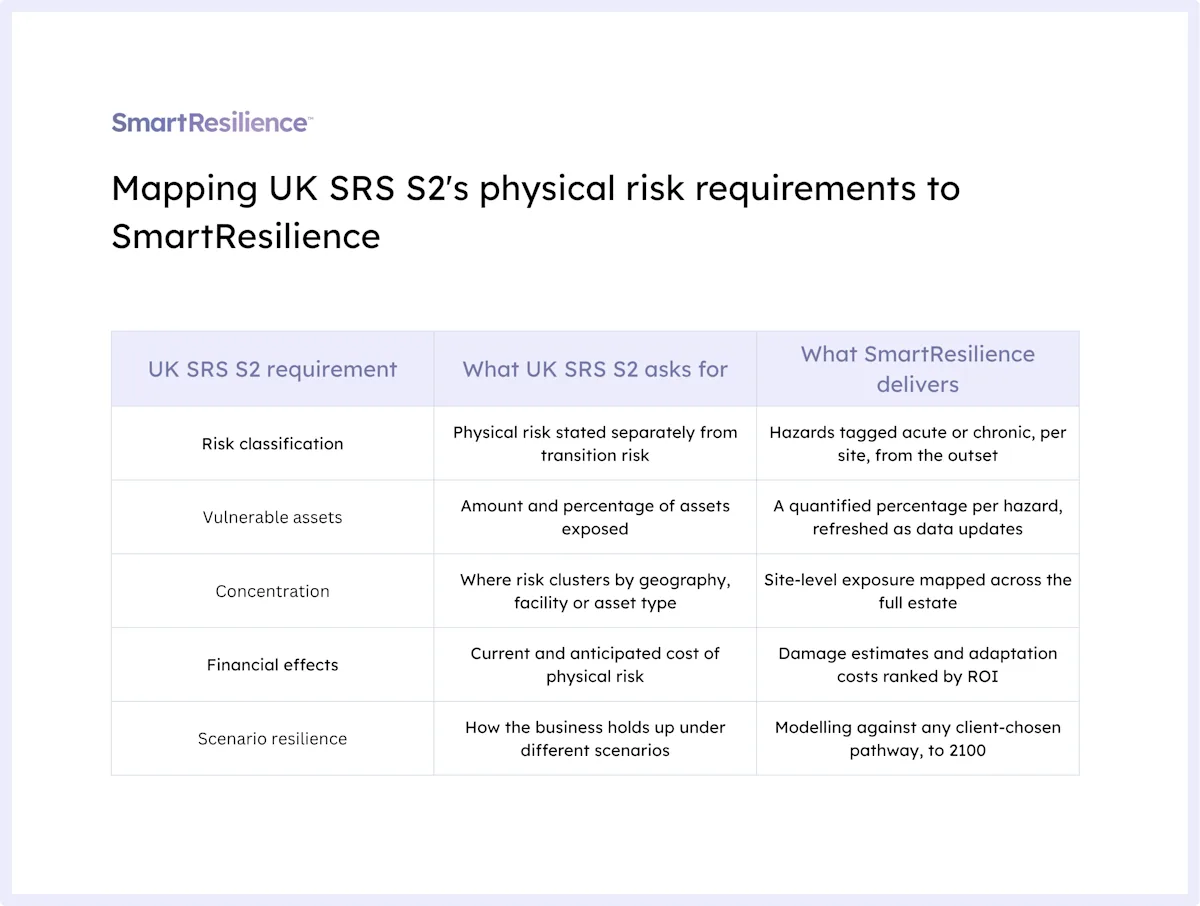
An auditor reviewing a UK SRS S2 disclosure looks for a quantified percentage of vulnerable assets, the financial figure behind it, and a documented trail showing how both were calculated.
A FTSE 100 client is a working example of this kind of quantification at scale. After a black box report from a global consultancy firm left the client without the granularity or transparency to act on it, the client ran a tender for a more transparent alternative and selected SmartResilience. Working across offices, factories, farms and warehouses in 50 countries, SmartResilience modelled floods, wildfires, cyclones, hurricanes, heat, drought and water stress at site level, then combined asset damage and business interruption methodologies to convert that exposure into a financial figure for each site. The client cut the cost of its climate analysis by half and used the resulting data to strengthen its climate-related reporting. Read the full FTSE 100 case study for the complete detail. That same site-level, multi-hazard translation into a financial figure is the foundation a UK SRS S2 vulnerable-assets figure draws on.
What's next for physical risk disclosure under UK SRS?
Scrutiny on physical risk figures will only increase as the FCA's rules move from proposal to policy statement and, potentially, to a mandatory requirement. Companies that treat an early UK SRS physical risk disclosure as a live capability, built once and kept current, rather than a document to file and revisit next year, will find the standard's eventual mandatory phase considerably less disruptive than companies starting from scratch.
FAQs
Is UK SRS mandatory, or still voluntary?
Voluntary today, though a mandatory phase looks highly likely. The FCA is consulting on requiring UK primary-listed companies already under TCFD to report using UK SRS S2, with a policy statement expected autumn 2026 and proposed rules from 1 January 2027, pending finalisation. A disclosure with genuine supply chain visibility typically takes around 18 months to build, longer than the gap between those two dates.
What counts as a physical climate risk under UK SRS?
Acute physical risk covers event-driven hazards such as storms, floods, droughts and heatwaves. Chronic physical risk covers longer-term shifts such as rising temperatures, precipitation changes, sea level rise, water stress and declining soil productivity.
How is UK SRS different from TCFD?
UK SRS S2 requires disclosure of climate-related opportunities as well as risks, which TCFD's original recommendations did not, and gives more flexibility on scenario selection rather than pointing to one preferred pathway.
How is UK SRS different from IFRS S2?
UK SRS S2 is the UK's own endorsement of the global IFRS S2 baseline. The acute and chronic physical risk architecture and the vulnerable-assets requirement carry over directly; the differences sit in UK-specific scope and timing.
Do companies need to quantify the financial impact of physical risk under UK SRS?
Yes. UK SRS S2 asks for the amount and percentage of assets vulnerable to physical risk together with the current and anticipated financial effects, not a qualitative risk description alone.
What happens if a company can't produce the required asset-vulnerability data?
A disclosure without a quantified, site-level figure tends to read as a general risk description rather than a compliant assessment, which is exactly the kind of gap external auditors and investors are most likely to press on.