
A compliance team preparing for UK SRS (the UK Sustainability Reporting Standards) usually starts with the same question: does this apply to us, and from when? Most coverage of the standard online answers that inconsistently, treating the FCA's (Financial Conduct Authority's) proposed 2027 date and company scope as settled fact well before the Policy Statement, the FCA's formal publication expected autumn 2026, that will actually confirm them. This piece sets out the complete UK SRS timeline and exactly who falls into scope today, separate from the detailed physical climate risk disclosure requirements covered in a companion article.
What is UK SRS, and when was it published?
The UK Sustainability Reporting Standards (UK SRS) are the UK's own sustainability disclosure standards, published in final form by the Department for Business and Trade (DBT) on 25 February 2026. They are built on the International Sustainability Standards Board's (ISSB) IFRS (International Financial Reporting Standards) S1 and S2 baseline, with a small number of UK-specific amendments.
UK SRS S1 covers general sustainability-related disclosures: governance, strategy, risk management and metrics across sustainability topics broadly.
UK SRS S2 covers climate-related disclosures specifically: physical and transition climate risk, scenario analysis and financial effects.
Publishing body: DBT published the standards themselves; the Financial Conduct Authority (FCA) separately decides whether and how to make them mandatory for listed companies.
What this article covers: the timeline and scope of UK SRS overall, and UK SRS S2 in particular, since that is where the FCA's mandatory proposal sits. The specific physical climate risk disclosure requirements within S2 (vulnerable assets, concentration, acute and chronic risk categories) are covered in a companion article, not repeated here.
Is UK SRS mandatory, or still voluntary?
Reporting against UK SRS is voluntary now: the FCA is consulting on making UK SRS S2 mandatory for certain listed companies, with a Policy Statement expected in autumn 2026 and proposed rules taking effect from 1 January 2027. The Financial Reporting Council's own FAQ confirms that status, stating plainly that reporting against UK SRS is not currently mandatory.
Today: any company can adopt UK SRS voluntarily, and some already do, ahead of any FCA rule.
Autumn 2026: the FCA aims to publish its Policy Statement, confirming (or amending) what CP26/5 currently proposes.
From 1 January 2027: FCA CP26/5 (Consultation Paper 26/5) proposes making UK SRS S2 climate disclosure mandatory for the listed companies it names, for accounting periods beginning on or after that date.
What "proposed" means in practice: CP26/5 is a consultation paper, not a finalised rule. The FCA can adjust scope, thresholds or transitional reliefs before the Policy Statement lands, so a company's compliance programme should track the proposal without treating any single detail as locked in.
Several widely-read guides to UK SRS state the 2027 date and company scope as if they were already confirmed. Building a disclosure programme against a proposal is still the right move, since the direction of travel is unlikely to reverse, but it is worth checking any internal briefing against the actual proposed-versus-confirmed status before it goes to a board or an auditor.
Who does UK SRS apply to under the FCA's proposals?
FCA CP26/5 (Consultation Paper 26/5) proposes full UK SRS S2 application to UK-incorporated companies listed under three UK Listing Rules (UKLR) categories: UKLR 6, 16 and 22, an estimated 515 companies in total.
UKLR 6 (commercial companies): the largest single category, covering most standard listed operating businesses.
UKLR 16 (non-equity shares): companies with listed debt or non-voting equity instruments.
UKLR 22 (transition category): a category created for companies moving between listing segments.
UKLR 14 and 15 (transparency-only): secondary listings and depositary receipts face a lighter regime, disclosing which home-jurisdiction standard they already follow rather than applying UK SRS S2 directly, since most already report under an ISSB-aligned standard elsewhere.
AIM-listed companies: AIM (the London Stock Exchange's junior market for growth companies) is not part of the categories named in CP26/5, and so falls outside the mandatory scope under current proposals.
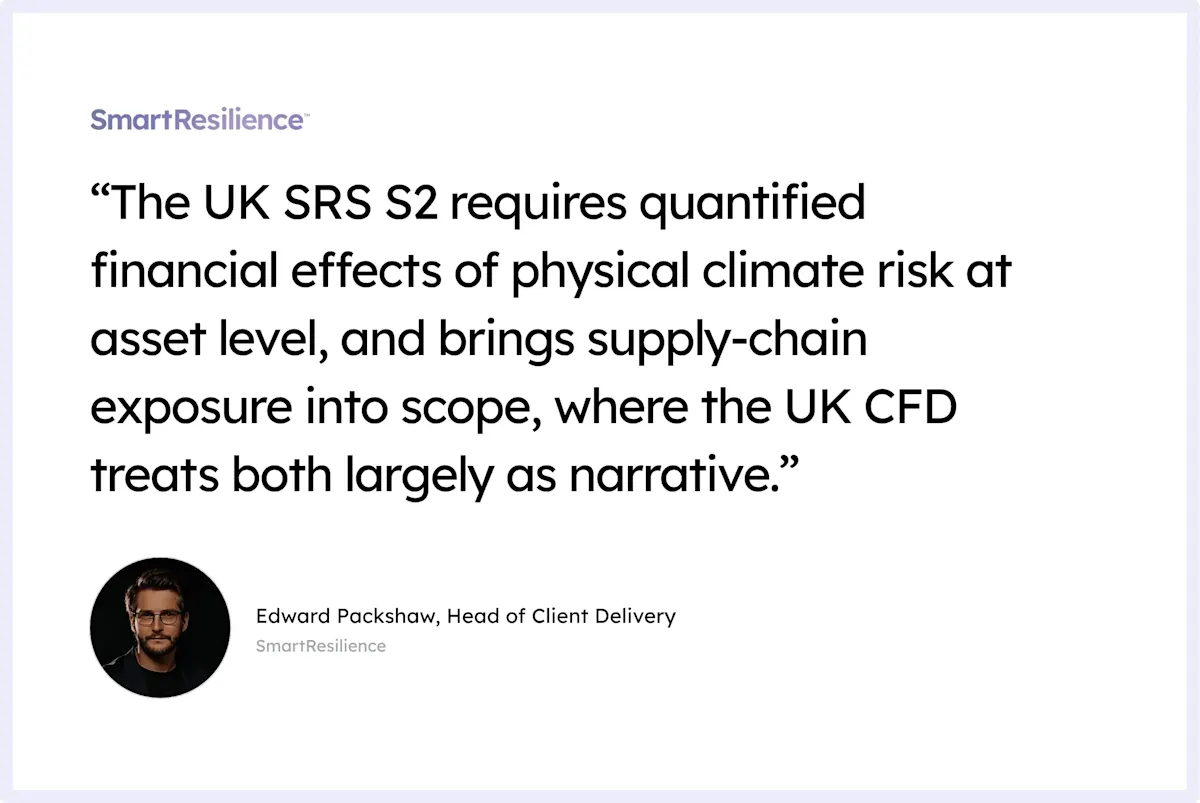
A company already meeting the UK's existing climate-related financial disclosure requirements under the FCA's Listing Rules, commonly nicknamed TCFD reporting, is the clearest signal that it sits inside one of the categories above, since CP26/5 proposes UK SRS S2 as a replacement for that existing requirement rather than an addition to it. The UK SRS S2 requires quantified financial effects of physical climate risk at asset level (AAL, PML, % of TIV), and brings supply-chain exposure into scope, where UK CFD (the existing Listing Rules requirement, formerly run under TCFD) treats both largely as narrative.
What's the difference between UK SRS and UK CFD, and what do I need to do about it?
UK CFD, the UK's existing climate-related financial disclosure regulation commonly nicknamed "TCFD reporting," already requires many premium and standard-listed companies to disclose climate risk within their annual report and accounts, largely as a qualitative narrative. UK SRS S2 keeps that same four-pillar architecture but closes three gaps a UK CFD-compliant company still has to address:
Quantification, not narrative: a vulnerable-assets percentage and financial effects in place of a qualitative risk description.
Transition risk in scope: treated as a disclosure requirement rather than an optional narrative.
Supply chain exposure included: brought into scope rather than limited to owned sites.
Being UK CFD-compliant today is a genuine head start on governance and strategy framing, not a reason to assume the harder quantification work is already done.
The bigger opportunity sits behind the compliance question itself. The ISSB framework UK SRS S2 is built on was designed as a business-resilience tool before it was a disclosure standard: a company that quantifies its physical and transition risk properly becomes more resilient to the underlying events, and a compliant disclosure is what falls out of that work rather than the goal of it. Investors increasingly ask a version of this same question directly, since a filed disclosure answers what a company reported, not whether the business would actually hold up under the risk it just described.
What is the UK SRS timeline, from consultation to mandatory reporting?
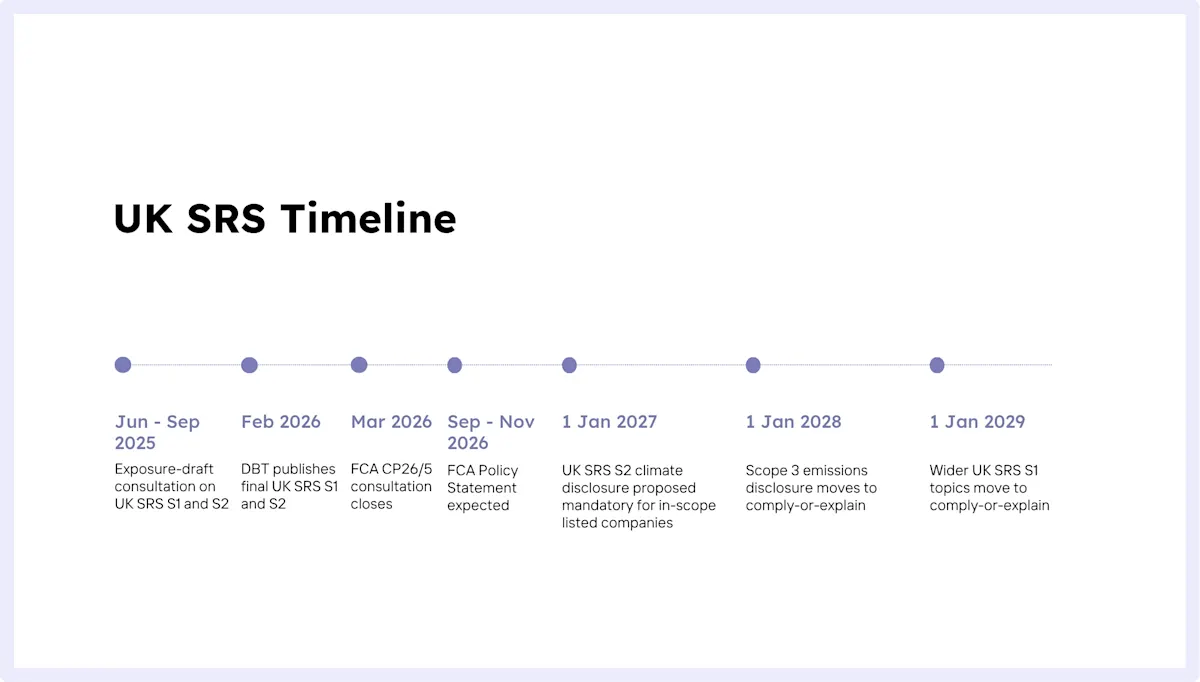
The UK SRS timeline runs from an initial consultation in mid-2025 through to phased mandatory dates stretching to 2029, in three broad stages.
Consultation and publication (2025 to early 2026): the exposure-draft consultation, followed by the DBT's final publication of UK SRS S1 and S2, and the FCA's own consultation on making S2 mandatory.
Decision (autumn 2026): the FCA publishes its Policy Statement, confirming or adjusting what CP26/5 currently proposes.
Phased mandatory reporting (2027 to 2029): the S2 climate date lands first, with Scope 3 and UK SRS S1 following on later comply-or-explain dates.
The table below sets out the dates behind each stage:
Will UK SRS apply to large private companies?
Not under current proposals: the government does not yet mandate UK SRS reporting for large private companies. The Modernising Corporate Reporting programme, which the government signalled in its 21 October 2025 Written Ministerial Statement, plans to consult during 2026 on extending reporting obligations to large private entities.
No confirmed threshold yet: the consultation has not started, so there is no proposed size test, turnover threshold or timeline specific to private companies.
Earliest realistic effect: no earlier than accounting periods beginning in 2028, and that depends on a consultation that has not yet opened.
What is driving the direction: the same Written Ministerial Statement also expands the government's broader corporate reporting reform programme, suggesting private-company coverage is a matter of when, not if.
What this means for a private company today: lenders and insurers increasingly ask for the same disclosure data independent of any legal requirement, so the absence of a mandatory date does not remove the commercial pressure to have it ready.
What should you do while the FCA's rules are still proposed?
While the FCA's rules are still proposed, companies should plan against the proposed date and scope rather than waiting for the Policy Statement, because the specific figures may shift but the overall direction will not reverse.
Confirm scope now, not later: checking whether a company sits in UKLR 6, 14, 15, 16 or 22 takes a single conversation with a company secretary or listing adviser, well before any disclosure work needs to start.
Separate the timeline question from the evidence question: knowing the date a company must report is a different exercise from building the quantified evidence UK SRS S2 actually requires.
Track the Policy Statement, not just the headline date: the detail most likely to move between now and autumn 2026 is transitional relief and scope boundary language, not the core 1 January 2027 target.
Keep physical risk disclosure detail separate: the specific requirements UK SRS S2 sets for physical climate risk (vulnerable assets, concentration, financial effects) sit outside this article's scope; they are covered in a dedicated companion piece.
How SmartResilience helps you stay ready while UK SRS scope and dates are finalised
Readiness for UK SRS should not depend on guessing the FCA's final scope or date, because SmartResilience Climate Assessments quantify site-level physical climate risk and the quantifiable parts of transition risk continuously, producing audit-ready IFRS S2 and UK SRS-aligned disclosure data and evidence that stays current as portfolios and rules evolve.
Physical risk, site by site: flood, heat, wind and water stress hazards quantified across an entire portfolio, with financial exposure figures available today for flood, wind and wildfire.
The quantifiable side of transition risk: carbon tax, energy, market and supplier-level exposure, modelled alongside physical risk rather than as a separate exercise.
Fully auditable methodology: every assumption and data source is visible on the platform and exportable to an external auditor, in contrast to a black-box consultancy report.
Continuously current: outputs update as a portfolio and the underlying rules change, so a shift in the FCA's final scope or date does not mean restarting a readiness project from scratch.
One FTSE 100 client used SmartResilience to bring clarity to a climate assessment that had previously come back from a leading consultancy as an unusable black box. Rolling the platform out across 53 countries took six weeks, and the client reported a 50% reduction in the cost of climate analysis while strengthening its climate disclosure capability in line with the regulation live at the time. The same auditable, site-by-site methodology now maps directly onto what UK SRS S2 asks for.
Confirm your UK SRS scope and evidence gap before the FCA's Policy Statement lands. Talk to SmartResilience by booking a demo today.
What happens once the FCA publishes its Policy Statement?
The FCA's Policy Statement in autumn 2026 may adjust dates, thresholds or transitional reliefs from what CP26/5 currently proposes, so this timeline is a working plan to revisit, not a one-time answer.
Confirm the mandatory date hasn't shifted from the proposed 1 January 2027 start.
Recheck UKLR scope boundaries, in case the final rules move a category in or out of full application.
Review transitional relief details for Scope 3 and UK SRS S1, since these are the areas most likely to change between CP26/5 and the confirmed rules.
Whatever the Policy Statement confirms, the practical next step stays the same: update the evidence-building work already under way rather than starting a new compliance project around a different set of dates.
FAQs - Frequently asked questions
Who has to comply with UK SRS, and by when?
Under FCA CP26/5, around 515 UK-listed companies in UKLR categories 6, 16 and 22 face proposed mandatory UK SRS S2 climate disclosure from 1 January 2027, pending the FCA's autumn 2026 Policy Statement.
Is UK SRS mandatory right now?
No. Reporting against UK SRS is voluntary today; mandatory application is proposed, not yet confirmed.
Are AIM-listed companies in scope?
No, AIM-listed companies fall outside the UKLR categories named in CP26/5 and are not part of the current mandatory proposal.
Will UK SRS apply to large private companies?
Not yet. The Modernising Corporate Reporting programme plans to consult on this during 2026, with any effect unlikely before periods beginning in 2028.
What happens to Scope 3 emissions and UK SRS S1 after the 2027 date?
CP26/5 proposes moving Scope 3 disclosure to comply-or-explain from 1 January 2028, and wider UK SRS S1 topics from 1 January 2029, both later than the initial S2 climate date.
Does UK SRS replace UK CFD reporting?
For companies already producing UK CFD-aligned disclosure (commonly nicknamed TCFD reporting) under existing Listing Rules, CP26/5 proposes UK SRS S2 as a replacement for that requirement rather than an addition to it.