
Both names turn up in the same sentence so often that it is easy to assume UK SRS (the UK Sustainability Reporting Standards) S1 and UK SRS S2 are two versions of the same requirement. They are not: one is the architecture every sustainability disclosure sits inside, the other a single climate-specific application of it, with its own dates and evidence demands. This piece sets out the structural split, then the practical question that follows from it: which one needs attention now, and which can wait.
What is the difference between UK SRS S1 and UK SRS S2?
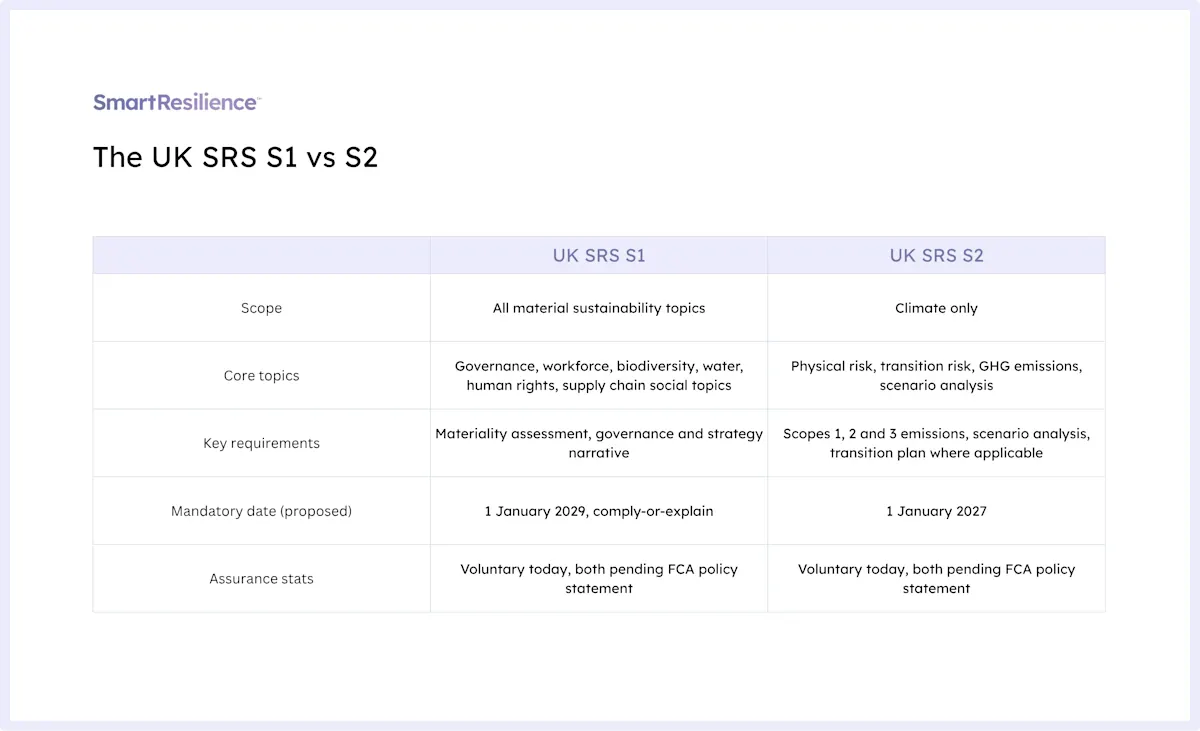
In UK SRS, S1 sets the general framework for disclosing any material sustainability-related risk, while UK SRS S2 applies that framework specifically to climate, covering physical risk, transition risk, GHG (greenhouse gas) emissions and scenario analysis. Both are the UK-endorsed versions of the ISSB's (International Sustainability Standards Board) global baseline, published together by the UK government on 25 February 2026.
S1 is the container: how a company identifies, governs and discloses any material sustainability topic, using four pillars: governance, strategy, risk management, and metrics and targets.
S2 is one application of that container: it reuses S1's structure and materiality process, then adds climate-specific substance.
Neither works alone: a company applying S2 still relies on the governance and materiality rules S1 defines, even while S1's own non-climate topics remain voluntary.
What does UK SRS S1 require, if it isn't about climate?
UK SRS S1 covers every material sustainability topic other than climate, using the same four-pillar structure S2 also uses. It is built on the ISSB's IFRS (International Financial Reporting Standards) S1 general requirements standard, which sets the baseline for disclosing material sustainability information across a company's value chain. It does not require GHG emissions disclosure, scenario analysis or transition plans; those sit entirely within S2.
Governance: how the board oversees sustainability risk and opportunity, and how management is structured to act on it.
Strategy: the material topics a company identifies, and how they connect to its business model and financial position.
Risk management: the process used to identify, assess and prioritise sustainability risks, separate from the risks themselves.
Metrics and targets: non-climate indicators, such as workforce composition, water use or human rights due diligence outcomes.
What does UK SRS S2 require on top of the S1 architecture?
UK SRS S2 inherits S1's materiality lens and four-pillar structure, then adds climate-specific substance on top. It cannot be applied in isolation from S1's architecture, even though S1's non-climate topics phase in later.
Physical risk: exposure to acute and chronic hazards such as flood, heat, wind and water stress, quantified at asset level.
Transition risk: exposure to policy, market and technology shifts as the economy decarbonises.
Emissions: Scope 1, 2 and 3 GHG emissions, reported against a defined baseline.
Scenario analysis: resilience testing against more than one plausible climate pathway, with methodology documented.
How do the two standards' mandatory dates differ, and why does the gap matter?
Both standards were published on 25 February 2026 and are currently voluntary. The Financial Conduct Authority's (FCA) consultation, FCA CP26/5, proposes UK SRS S2 climate disclosure as mandatory from 1 January 2027 for the listed companies it names, while S1's non-climate topics are proposed for comply-or-explain status from 1 January 2029, a two-year gap. Both dates are pending the FCA's autumn 2026 policy statement.
S2 pressure is close. A company in scope has roughly eighteen months to build a climate evidence base that will survive external scrutiny.
S1 pressure is further out and unconfirmed. No date has been finalised, so treating S1 as equally urgent right now pulls attention and budget away from the nearer deadline.
The practical conclusion is climate-first. With S2 firming up and S1 still proposed, prioritising a climate-first reporting programme over parallel S1 investment is the pragmatic reading of where the regulation is heading, not a hedge.
Practical tip: build the S2 evidence base to a standard an external auditor would expect, and treat S1 preparation as a scoping exercise, not a build, until its own date firms up. Companies should take independent legal and accounting advice on how these proposed dates apply to their specific circumstances, since both remain subject to the FCA's autumn 2026 policy statement.
Can a company apply UK SRS S2 without doing UK SRS S1 work?
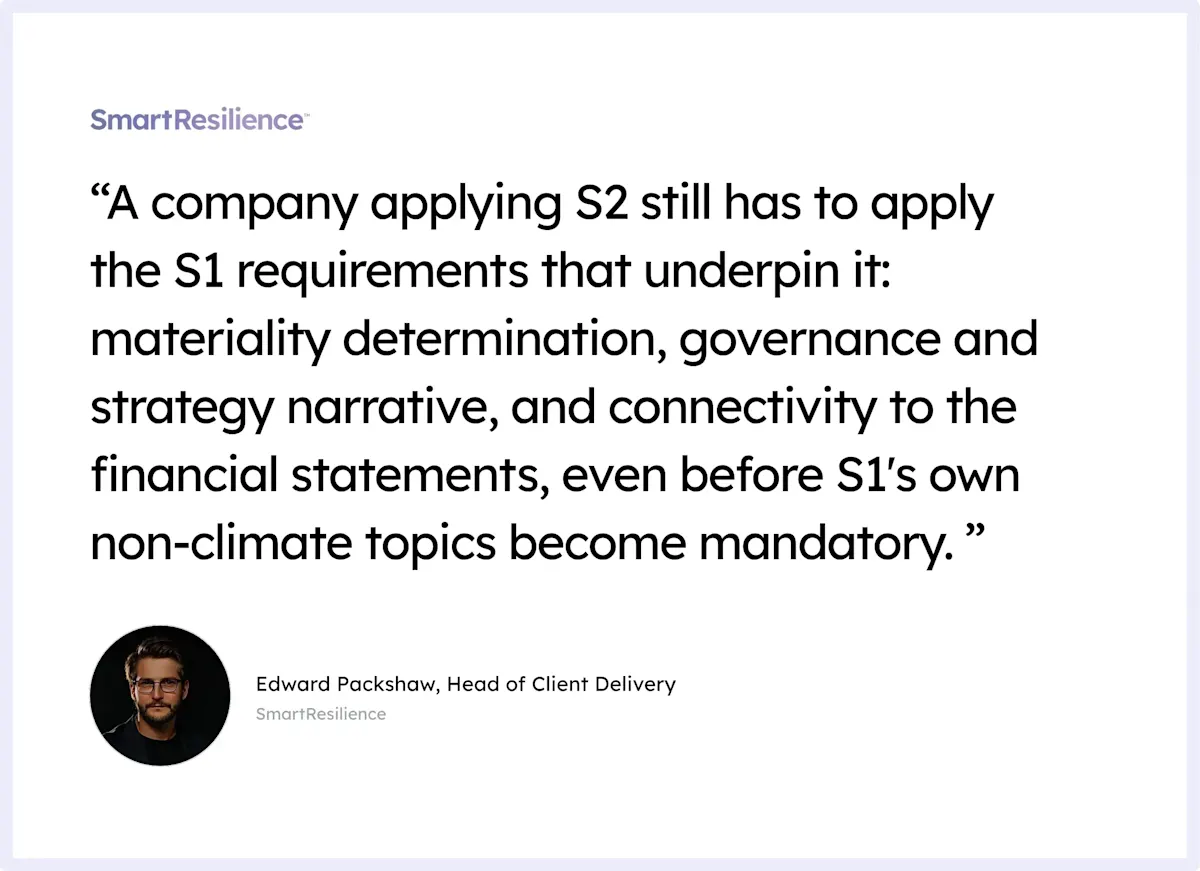
A company applying S2 still has to apply the S1 requirements that underpin it: materiality determination, governance and strategy narrative, and connectivity to the financial statements, even before S1's own non-climate topics become mandatory. What a company can defer is the non-climate substance itself.
Cannot defer: the materiality process, governance narrative and financial-statement connectivity that S1 defines and S2 depends on.
Can defer: biodiversity, workforce, human rights and the other non-climate topics that sit inside S1 alone.
The distinction matters for planning. A programme that skips S1's foundational elements to focus only on S2's climate content will produce a disclosure that does not hold together on review.
The Financial Reporting Council's (FRC) Sustainability Reporting Developments FAQ sets out this voluntary-today, proposed-mandatory status for both standards in more detail.
What's new if you already have TCFD reporting in place?
If you already have TCFD reporting in place, S2 turns several of its recommendations into firmer requirements. TCFD (the Task Force on Climate-related Financial Disclosures) was folded into the ISSB, rather than as a framework in its own right, but it gave most companies the four-pillar architecture S2 keeps.
Quantification, not narrative: asset-level financial figures, such as average annual loss or percentage of assets in high-risk zones, which most TCFD reports never built.
Scope 3 emissions data: TCFD reports often stated supply chain emissions as an ambition. S2 expects a delivered figure.
Assurance-ready methodology: scenario assumptions documented well enough to survive external scrutiny, not just referenced.
Financial-statement connectivity: an explicit link to the audited accounts, not a standalone climate section.
This also changes who needs to be in the room: finance for materiality and financial-statement connectivity, procurement for Scope 3 data, and an assurance provider brought in early enough to shape the evidence rather than review it afterward.
HR and health, safety and wellbeing teams belong in S2 conversations too, wherever physical climate risk reaches employees directly. It is the broader ESG functions covering S1's non-climate topics that do not need pulling in yet, following the climate-first sequencing above.
Which team or workstream should own each standard?
S2 usually sits with the sustainability or risk team already running TCFD-era climate reporting, while S1's non-climate topics split across HR, procurement and broader ESG functions instead. Hazard data, financial quantification and scenario modelling extend the existing climate team's capability for S2, and each S1 function is already accountable for its own topic area outside the climate remit.
S2 ownership: sustainability or risk teams with TCFD experience own the physical-risk core, with legal tracking transition risk planning against the fast-moving sustainability regulation space, and finance and legal together on materiality and disclosure sign-off.
S1 ownership (when active): HR for workforce topics, procurement for supply chain social topics, and ESG functions for biodiversity and water.
The gap to watch: S2's early team is necessarily risk- and finance-led, but climate risk management is a whole-company issue. Bringing a representative cross-functional group into the conversation now, ahead of S1's own dates, builds that understanding early instead of leaving it to a scramble closer to 2029.
Choosing the right tooling matters as much as choosing the right team, and S1 and S2 call for different capabilities from a vendor.
How SmartResilience helps you build the UK SRS S2 evidence base
SmartResilience Climate Assessments deliver the physical-risk core of UK SRS S2 directly: asset-level hazard exposure across flood, heat, wind and water stress, scenario analysis, and the physical-risk metric expressed as average annual loss, probable maximum loss and percentage of total insured value in high-risk zones. Every output carries transparent, auditable methodology a company can hand to its auditor.
Physical risk, delivered directly: site-level hazard exposure and financial quantification, continuously updated as data and portfolios change.
Transition risk, facilitated: worksessions and quantitative modelling of carbon tax, energy, market and supplier exposure, delivered through a specialist partner integrated into the platform.
Capital planning, connected: transition risk is the exposure itself, such as carbon taxes, shifting customer preference and tightening regulation, while the capital plan is the investment case for responding to it, covering both physical adaptation and transition costs.
IFRS S2-aligned disclosure drafting: the physical-risk narrative drafted for the company's disclosure, with statutory accounting and audit integration staying with the company and its auditors.
A climate-first starting point: with S2 prioritised over S1 in UK guidance, building this evidence base first is where SmartResilience's own focus sits.
SmartResilience does not cover UK SRS S1's non-climate topics: governance, workforce conditions, biodiversity, water, human rights and supply chain social disclosure sit outside its scope, and a company needs separate tooling or in-house process for that half of the framework. Group 1 Automotive used this approach to bring flood risk under control across its 150+ UK dealership network after a major acquisition doubled its portfolio overnight, building the kind of auditable evidence base that also underpins a UK SRS S2 disclosure.
SmartResilience
See SmartResilience in action
Book a free demo tailored to your organisation and assets.
Book a free demoWhat's next for the S1/S2 split?
The UK SRS timeline is still awaiting the FCA's autumn 2026 policy statement, which may adjust S2's proposed date and scope, and S1's 2029 comply-or-explain phase-in is even further from settled. Treat the split between the two standards as a planning tool now: build the S2 evidence base against the nearer date, and sequence S1 preparation once its own timeline firms up, rather than waiting to resolve every open question first.
FAQs
What is the difference between UK SRS S1 and S2?
S1 is the general sustainability disclosure framework covering any material topic. S2 applies it specifically to climate: physical risk, transition risk, emissions and scenario analysis.
Does UK SRS S1 have a different mandatory date than S2?
Yes. FCA CP26/5 proposes S2 as mandatory from 1 January 2027, while S1's non-climate topics are proposed for comply-or-explain from 1 January 2029, both pending confirmation.
What does UK SRS S1 actually require, if it's not climate?
Disclosure of any other material sustainability topic, including governance, workforce conditions, biodiversity, water, human rights and supply chain social topics, using the same four-pillar structure as S2.
Can a company report under S2 without doing S1?
Not fully. S2 relies on S1's materiality process, governance narrative and financial-statement connectivity, even before S1's own non-climate topics become mandatory.
Does climate risk software help with S1, or only S2?
Depends on the vendor. SmartResilience covers UK SRS S2, delivering physical risk directly and facilitating transition risk through a specialist partner, but does not cover S1's non-climate topics.
What do I need to add to my TCFD reporting to comply with UK SRS S2?
Quantified physical-risk metrics, Scope 3 emissions data, assurance-ready scenario methodology, and an explicit link between the disclosure and the audited financial statements.