Climate X sells climate risk analytics to banks, real estate investors and insurers, and it is one of the more visible UK names in the category. A property or sustainability lead at a multi-site operator often meets it through a lender's due diligence or a group-level mandate, then finds the outputs answer a question they were not asking. This guide reviews the alternatives, starting with what Climate X does.
What is Climate X?
Climate X is a London-based climate risk analytics company whose platform, Spectra, models physical climate hazards at individual asset level. The company also has a New York office, and its investors include GV, CommerzVentures and PropTech1 Ventures.
What Spectra covers, according to Climate X's own product pages:
Hazard coverage: Spectra models 12 physical hazards, with a wildfire model resolved at 30 metres globally.
Asset coverage: The platform holds analysis across 1.5 billion assets worldwide.
Financial output: Spectra translates hazard exposure into asset-level financial loss estimates, then aggregates them to portfolio level.
For a lender assessing a mortgage book or an investor pricing a portfolio, that does the job it was designed for.
Why do businesses look for an alternative?
Buyers most often look for an alternative to Climate X for four reasons, and only one of them concerns the platform's quality.
Climate X quotes per engagement rather than publishing rates, so a buyer cannot size the cost before entering a sales conversation.
Climate X does not publish full technical documentation or peer-reviewed detail on its own site, which makes the assumptions behind an output harder to interrogate. A sustainability lead defending a number to an auditor tends to want more than a score.
The platform and its reporting alignments are built around the obligations financial institutions carry, so an operator can end up paying for capability that answers someone else's regulatory question.
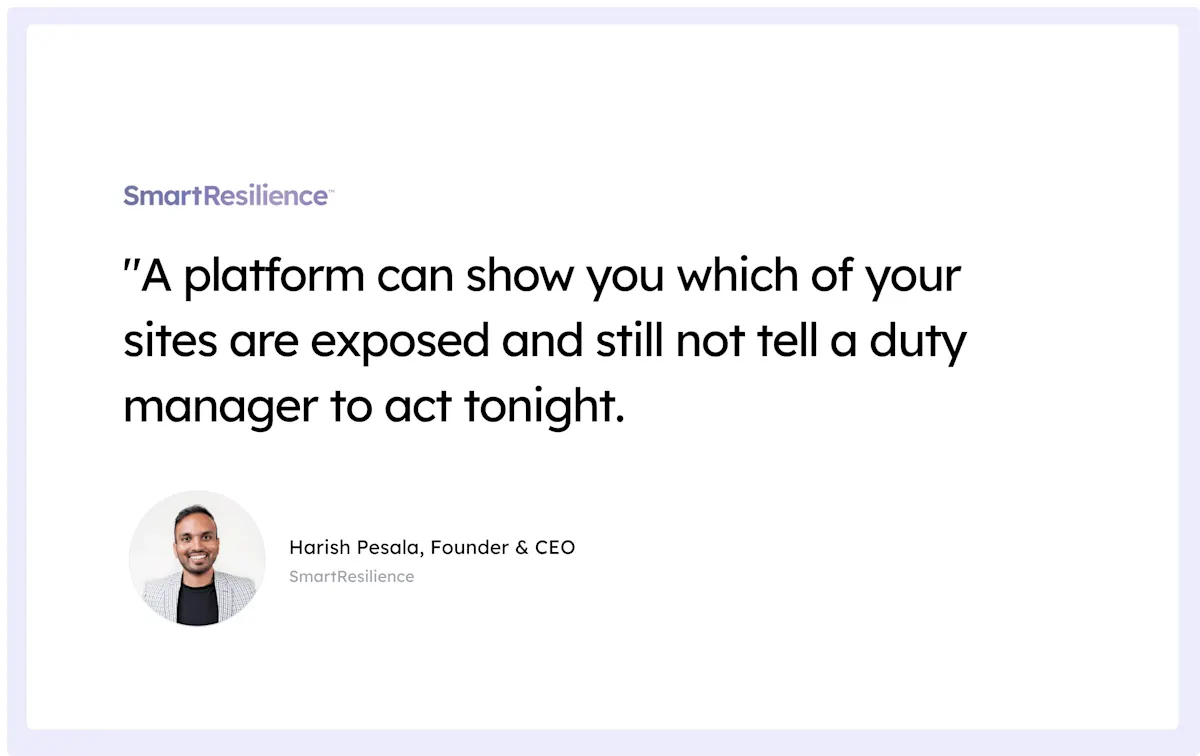
Climate X doesn't have a real-time early warning or site-level alerting. A platform without it can show which sites are exposed, and it cannot tell a duty manager to act tonight.
If the sticking point is cost or contract structure, our guide to the eight questions to ask before you buy covers what to get in writing. If the sticking point is the fourth reason, the problem is not the vendor.
Who is Climate X built for?
Climate X is built for the institutions that lend against and invest in buildings, which is a different reader from the one running them. Both sets of needs are legitimate. Neither substitutes for the other.
An operator running an estate of UK sites has to answer three things:
Which of my sites is at risk in the next few days, rather than in 2050?
Who receives the warning, and what do they do when it arrives?
What evidence do I put in front of an underwriter at renewal?
The clearest signal of intended buyer sits in the regulatory alignments Climate X advertises. Spectra's outputs align to IFRS S2, the international climate disclosure standard, to the EU's Corporate Sustainability Reporting Directive (CSRD), and to the Prudential Regulation Authority (PRA) supervisory statement SS5/25, published in December 2025, which sets out how the PRA expects banks and insurers to manage climate-related risks.
The PRA supervises financial firms. A supermarket chain or a hotel group carries no PRA obligation at all, so a retailer buying against that standard is paying for capability aimed at its own lender.
What a lender or investor needs | What an operator needs | |
The question | How exposed is this asset over decades? | Which of my sites is at risk this week? |
Time horizon | Projections to 2050 and 2100 | The next 48 hours, and this winter |
Who acts on it | A credit or investment committee | A store manager and a facilities team |
The output | A risk score and a disclosure metric | A warning, a response plan and evidence for renewal |
This gap is not theoretical for operators. The government's own flood warning service covers flooding from rivers, the sea or groundwater, and it states plainly that it does not cover surface water flooding, also known as flash flooding, which is exactly the hazard that catches commercial sites without notice.
The cost side is moving as well. UK insurers paid £6.1bn in property claims in 2025 according to the Association of British Insurers (ABI), £1.2bn of it weather-related and up 14% year on year. Swapping one analytics platform for another will not change either fact, because they are all answering the lender's question well. Our comparison of climate risk platforms for multi-site UK estates filters the market by operational criteria instead.
What are the alternatives to Climate X?
The climate risk management alternatives to Climate X fall into two groups: one operational platform built for site-level action, and three analytics platforms competing for the same financial-sector buyer Climate X serves.
1. SmartResilience
Best for: SmartResilience suits UK multi-site operators in retail, hospitality, logistics and property who want to be able to act on climate risk rather than only measure or report it.
SmartResilience combines continuous site-specific monitoring with insurance-ready reporting, so an estate's risk picture updates as conditions and the estate itself change.
Key capabilities:
Continuous monitoring: The platform monitors every site in the estate continuously rather than at a single point in time.
Site-specific early warning: Store managers, risk teams and leadership receive alerts calibrated to each location before a weather event escalates.
Insurance-ready reporting: Brokers and underwriters receive auditable, site-level evidence to bring into a renewal conversation.
Transparent methodology: The platform exposes its data lineage and assumptions, and those are exportable to an auditor.
Limitations: SmartResilience quotes per engagement rather than publishing rates, so a first conversation is needed to size cost for a specific estate.
Pricing: SmartResilience quotes per engagement and does not publish a rate card.
2. Jupiter Intelligence
Best for: Jupiter Intelligence suits large financial institutions, including banks and asset managers, that need portfolio-wide physical risk analytics.
Jupiter Intelligence runs six applications on its ClimateScore Global platform, covering portfolio and asset-level risk analysis, disclosure, entity modelling, custom metrics, adaptation modelling and model validation.
Key capabilities:
Breadth of coverage: The platform analyses risk across 22.3 billion locations globally.
Long-horizon scenarios: Jupiter Intelligence models three scenarios in five-year increments out to 2100.
Adaptation modelling: Its Adaptation Hub models resilience measures and the return on investment attached to them.
Limitations: Jupiter Intelligence describes no automated disclosure report generation, so reporting needs assembling downstream, and it does not fully publish its methodology or confidence intervals. It describes no real-time alerting.
Pricing: Jupiter Intelligence does not publish rates and works through enterprise onboarding and consulting partnerships.
3. XDI
Best for: XDI suits engineering and asset teams that want granular, asset-level vulnerability modelling.
The XDI Climate Risk Hub models nine climate hazards across four scenarios in five-year steps to 2100, at resolutions as fine as five metres.
Key capabilities:
Sub-asset resolution: The platform models hazards down to the failure point within a single asset.
Long-horizon planning: Analysts can test adaptation and capital decisions across four scenarios to 2100.
Scale of screening: XDI screens portfolios ranging from one asset to tens of thousands.
Limitations: XDI does not consistently model return periods or quantify uncertainty, and it describes no insurance-specific use case and no continuous alerting on its own site.
Pricing: XDI does not publish rates and offers off-the-shelf reports, application programming interface (API) access and bespoke engagements.
4. S&P Global Climanomics
Best for: S&P Global Climanomics suits enterprises already working inside S&P workflows that need portfolio-level disclosure reporting.
S&P Global Climanomics models financial impacts across eight decades and four scenarios drawn from the Intergovernmental Panel on Climate Change.
Key capabilities:
Asset-type depth: The platform covers more than 300 asset types using more than 1,200 impact functions.
Disclosure alignment: S&P Global structures the outputs for established disclosure frameworks.
Published pricing: S&P Global lists a UK price, which almost no competitor in this category does.
Limitations: S&P Global Climanomics describes no continuous alerting and no insurance-specific use case. Its current availability through UK public-sector procurement is unclear and should be confirmed directly.
Pricing: S&P Global has listed Climanomics at £16,200 a licence through UK government procurement, with a free trial covering up to three assets.
5. Moody's Climate on Demand
Best for: Moody's Climate on Demand suits organisations inside Moody's risk workflows that want location-level damage and disruption estimates.
Moody's Climate on Demand produces forward-looking, location-specific estimates of damage and business disruption for real assets, positioned as foundational data feeding wider risk analysis.
Key capabilities:
Location-level estimates: The product estimates event damage and business disruption for specific locations.
Peril coverage: The data covers flood, heat stress, tropical cyclone, sea level rise, water stress and wildfire.
Workflow integration: Outputs feed Moody's broader risk and analytics products.
Limitations: Moody's Climate on Demand describes no continuous site-level alerting and no insurance-evidence capability, and it is positioned as a data layer rather than an operational platform.
Pricing: Moody's does not publish rates for Climate on Demand.
How SmartResilience helps you act on climate risk across a multi-site UK estate
With SmartResilience, teams turn a completed risk assessment into a live operational capability, so the data that satisfies a disclosure requirement is the same data a site manager acts on.
Sainsbury's runs SmartResilience across 1,000+ sites. The starting point was Storm Desmond in 2015, which flooded several flagship stores and forced closures lasting several weeks, with damage and lost revenue running to several millions.
When Storm Eunice arrived in February 2022, the Tadcaster store received a flood warning 12 hours ahead, a full seven hours before the Environment Agency's own alert. Flood waters outside reached 4.51 metres.
The protective measures the team deployed in that window held the water entering the store to 5cm, and the store lost virtually no stock. After a single day of closure, specialist teams started work at 6am and the shop reopened that afternoon.
What that looks like in practice across an estate:
Warnings that reach a named person: Site managers receive alerts calibrated against what has actually happened at their location, rather than a regional notice sent to a shared inbox.
Site-level financial exposure: Finance teams see annualised losses and event costs per site, which is the form exposure needs before a budget conversation.
Adaptation ranked by return: Property teams see which measures at which sites repay the spend first.
Evidence an underwriter will use: Auditable, site-level records of exposure and of the actions taken sit ready for a renewal conversation.
An estate that treats climate risk as an operational system changes what it can do next winter, not just what it can disclose. If your shortlist is built from platforms designed for the institutions lending against your buildings, the question worth asking is what you want someone to be able to do on the day a storm arrives.
SmartResilience
See SmartResilience in action
Book a free demo tailored to your organisation and assets.
Book a free demo