

Boards and investors increasingly ask sustainability and risk teams to name the exact methodology behind their climate risk numbers, not just supply the numbers themselves. They want a recognised, externally governed standard, not a framework built in-house. PCRAM, the Physical Climate Risk Appraisal Methodology, gives real-asset owners exactly that: a named framework for pricing how floods, storms, heatwaves and drought affect buildings, infrastructure and land.
What is PCRAM?
PCRAM stands for the Physical Climate Risk Appraisal Methodology, described by its governing body as offering "systematic, objective, and replicable guidelines for integrating physical climate risks into investment decision-making." It links climate hazard data directly to the value of a real asset and the case for adapting it, rather than describing exposure in the abstract.
Purpose: PCRAM measures how a flood, storm, heatwave or drought would actually change the value of a real asset, a building, a piece of infrastructure or a plot of land, rather than simply flagging that the hazard exists nearby.
Origin: the methodology's original authors first published it as the Physical Climate Risk Assessment Methodology, and IIGCC renamed it the Physical Climate Risk Appraisal Methodology when it released version 2.0, a shift that marks the move from simply describing a hazard to pricing what it actually does to an asset.
Scope: flood, extreme heat, storms and drought are the four hazards PCRAM covers, and it applies across infrastructure, real estate and energy assets, everything from a road bridge to an office building to a solar farm.
Applicability: PCRAM is not built around any one country's rules or one region's climate, so government bodies and private companies both already use it today.
Who governs PCRAM?
PCRAM was conceptualised by the Asset Design & Structuring working group of the Coalition for Climate Resilient Investment (CCRI), with special contribution from Mott MacDonald, a global engineering and infrastructure consultancy, and 35 collaborating institutions. Development transferred to the Institutional Investors Group on Climate Change (IIGCC) in March 2023, and PCRAM 2.0 was funded by UK International Development and published open source through PreventionWeb.
Origin and governance: CCRI's Asset Design & Structuring working group originated PCRAM, and IIGCC has governed it since March 2023, so a risk lead answering a board's question can name a specific working group and a specific governing body rather than an anonymous consultancy.
Relationship to CRIF (Climate Resilience Investment Framework): IIGCC sums up the difference between the two in one line: CRIF is the strategy, the big-picture plan for how an investor manages climate resilience across everything it owns, while PCRAM is the analysis, the detailed number-crunching on individual assets that feeds into that plan.
What changed in PCRAM 2.0: version 2.0 lets an investor run the appraisal across an entire portfolio or fund instead of one asset at a time, and it looks at how each asset behaves as part of the wider system around it (what IIGCC calls systems analysis). It also considers how resilience measures can add value to an asset rather than just protect it (value enhancement), and checks insurability and credit quality, meaning whether an asset can still get insured and how a lender or rating agency views the risk of lending against it. It brings in nature-based solutions such as restored wetlands or mangroves that soak up floodwater, and it now covers real estate as well as infrastructure and energy.
Who uses it: infrastructure investors, energy companies and asset managers were already using PCRAM, and since version 2.0 arrived, real estate developers and managers use it as well.
Being able to name PCRAM specifically is what lets a risk lead answer a board or investor's question about methodology in one sentence, rather than defending an in-house approach nobody outside the company recognises. That difference shows up directly in financing and insurance conversations, not just in an internal report.
Why is PCRAM valuable?
PCRAM is valuable because it gives every user the same standardised, comparable framework to work from, rather than each company inventing its own approach to physical climate risk. That consistency is what makes adaptation planning both robust and credible, which matters most in investor-facing communication.
Standardising how physical climate risk is measured: every company applying PCRAM follows the same method, so the resulting figures can be compared across assets, across a portfolio or between different investment targets, not just trusted in isolation.
Grounding adaptation planning in a tested structure: every user works through the same four stages, from scoping through to value enhancement, rather than each company building its own shortcut for one specific deal.
Carrying weight in investor-facing communication: a number produced by an externally governed, consistently applied methodology is harder to dismiss in a board or investor conversation than a bespoke internal model nobody outside the company can verify.
What are the 4 stages of the framework?
PCRAM works through four stages, each with its own objective, a set of sub-tasks, defined outputs and a decision gate the project team has to clear before moving on to the next one.
Stage 1: Scoping and data gathering
Objective: determine whether the team has enough reliable data to proceed, covering project initiation, defining the project itself, and gathering and checking the data.
Outputs: an initial climate study, a list of critical asset and system components, the KPIs and risk appetite the appraisal will use, and a Base Case cashflow forecast.
Example: picture an infrastructure fund considering acquiring a solar farm. This is the stage where the fund confirms which hazards actually matter, hail and rising average temperatures among them, and checks it has enough historic weather and output data on the site before going any further.
Stage 2: Materiality assessment
Objective: assess how vulnerable the asset actually is, working through hazard scenarios, impact pathways and financial sensitivities on return and debt, and distinguishing sudden acute damage from the kind of chronic wear that gradually erodes performance.
Outputs: a detailed climate study, a quantified list of impacts and their severity by component, and one or more Climate Case cashflow forecasts.
Example: for that same solar farm, this stage might show a specific hailstorm scenario is severe enough to crack panels and cut output for weeks, a risk material enough to lower the farm's projected revenue and change the return the fund can expect to earn on the deal.
Stage 3: Resilience building
Objective: identify the available adaptation options, weighing up the cost and availability of hard, structural measures, capital expenditure such as flood defences, against soft, operational ones, changes to how the asset or its systems are run, then repeating the materiality assessment against the improved condition.
Outputs: cost and benefit figures for each suitable measure, an adaptive pathway, and a Resilience Case cashflow forecast.
Example: the fund might compare fitting impact-resistant panel coatings against relocating the most exposed rows of panels, working out which option protects revenue at the lowest cost.
Stage 4: Value enhancement
Objective: optimise resilience while transferring residual risk, identifying resilience metrics, comparing the internal rate of return (IRR) with and without those measures, and checking how they affect insurability and credit quality.
Outputs: an investment case narrative and a picture of what the improved resilience means for value across the investment chain, investors, lenders and insurers alike.
Example: if those coatings make an outage less likely, the fund can take a stronger case back to its insurer for lower premiums, improving the deal's projected return directly.
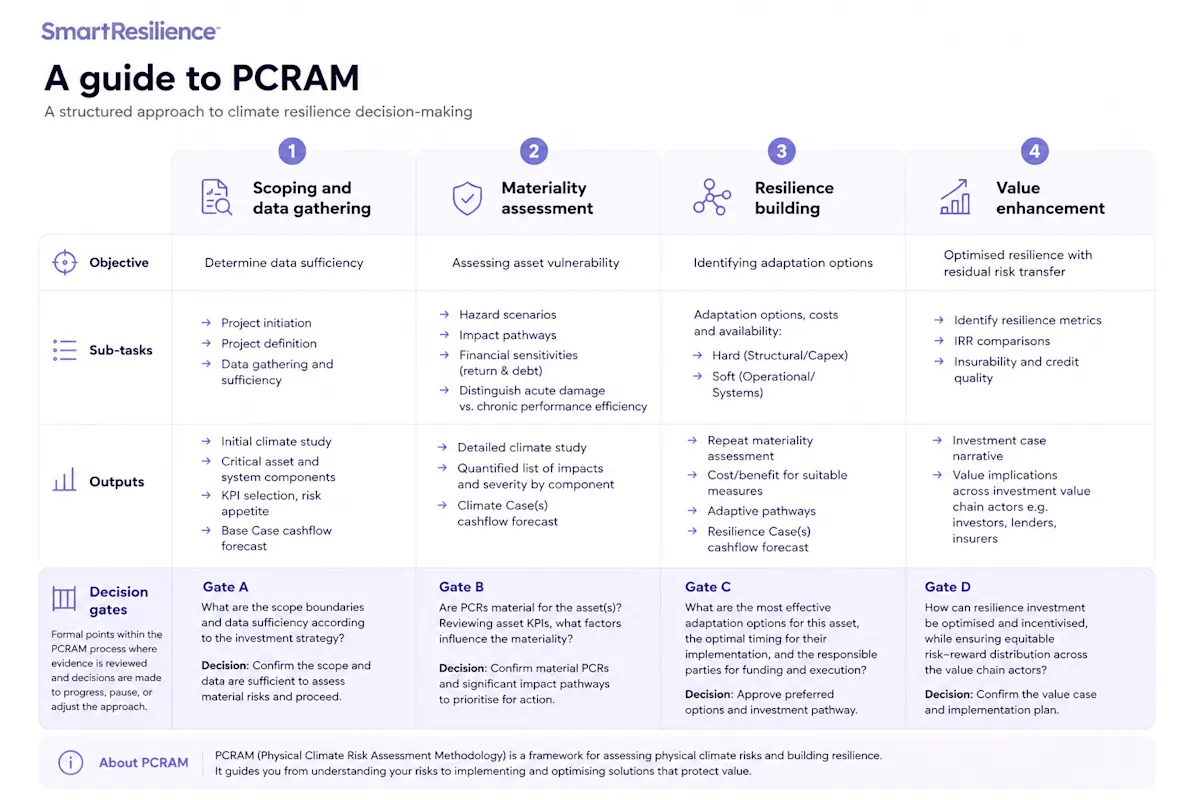
Diagram adapted from IIGCC, Physical Climate Risk Appraisal Methodology (PCRAM) 2.0 (2025)
Our guide to identifying and assessing physical climate risk covers this same identify-quantify-act logic in more operational detail. What makes this sequence matter commercially is the last step: it turns an abstract hazard into a specific figure a chief financial officer (CFO) or investment committee will actually engage with, which is what moves a decision from deferred to funded.
How does the PCRAM methodology apply to portfolios and funds?
PCRAM 2.0's headline addition condenses the four asset-level steps above into a three-step version that works across an entire fund or portfolio, rather than asking a team to repeat all four steps in full for every single asset it owns.
Scoping and data gathering: the team runs the same first step described above, but gathers hazard data across the whole portfolio in one exercise rather than site by site, so exposure can be compared across dozens or hundreds of assets at once.
Materiality assessment: this is where the portfolio version does its most distinctive work. The team first ranks every asset by how exposed it is, a step IIGCC calls a materiality screen, and only then runs the full four-step asset-level appraisal, scoping, materiality, resilience building and value enhancement, on the specific assets that screen as most exposed. An investor gets the full, detailed appraisal on the sites that actually need it, rather than paying for that same depth of work on every low-risk asset in the portfolio.
Reassessing portfolio exposure: the reduced vulnerability achieved through resilience measures on those flagged assets gets fed back into the portfolio-wide exposure figures, so the whole portfolio's risk picture updates, not just the one or two assets that were fixed.
IIGCC is candid that this part of the methodology is still maturing, noting directly that "further development is needed in the portfolio and fund lens." That kind of transparency about a known limitation is exactly what a reader should expect from a methodology built to be recognised and relied on.
Set side by side, it is clear that the shift from 1.0 to 2.0 is a widening of scope, not just a version number:
PCRAM 1.0 | PCRAM 2.0 | |
Unit of analysis | Single asset | Asset, fund and portfolio |
Context considered | Asset in isolation | Asset within its surrounding system |
Outputs | Risk exposure and adaptation cost-benefit | Adds insurability and credit quality metrics |
Adaptation options | Primarily engineered measures | Includes nature-based solutions |
What does the PCRAM process leave for you to monitor?
PCRAM is not a one-time exercise, but its guidance does not specify how an organisation should track what it asks teams to watch for day to day. IIGCC calls this a "trigger point." PCRAM's guidance also tells teams to keep watching a risk in a register even after they judge it not currently material.
What PCRAM specifies: IIGCC's guidance defines a trigger point, a specific warning sign that shows a risk is getting close to a threshold that matters, and instructs teams to keep watching for one between formal review cycles, not just at the next scheduled appraisal.
What it leaves open: PCRAM does not specify how an organisation should track a live trigger point day to day, especially across a portfolio where sites get bought, sold or leased constantly.
Independent evidence of the gap: a Real Assets analysis of the methodology separately flags this "iterative character" as a genuine barrier to adoption, because a team must update its findings every time new data comes in rather than treat them as a one-off output it can file away.
Teams facing exactly this gap, particularly after a merger or acquisition changes the shape of a portfolio overnight, are the ones who benefit most from pairing a PCRAM-aligned appraisal with a live monitoring capability. Our climate risk assessment process guide covers this in more operational detail.
How SmartResilience helps you operationalise a PCRAM-aligned approach
PCRAM already tells organisations to watch for a trigger point between formal appraisals. The practical question is how to do that day to day, across a portfolio that keeps changing shape, without waiting for the next scheduled review to find out a threshold has been crossed.
Portfolio-wide visibility: SmartResilience gives a risk lead one continuously updated view of every asset's exposure, so a new site, a fresh acquisition or a lease change shows up immediately instead of sitting as an unpriced blind spot until the next scheduled review.
Early warning: as conditions move toward a trigger point, SmartResilience alerts site managers and risk teams before a threshold is actually crossed, so a team can act to avoid a cost rather than pay for the damage afterwards.
Insurance-ready reporting: underwriters and lending teams ask for structured, auditable proof that an organisation is actively managing its risk, and SmartResilience produces exactly that, so a risk lead can walk into a renewal conversation asking for better terms instead of defending the portfolio.
Board-ready evidence: risk, sustainability and leadership teams can all point to the same up-to-date picture in one meeting, because SmartResilience gives them a single shared view instead of separate reports each team has to reconcile beforehand.
When Group 1 Automotive doubled its UK dealership network overnight through an acquisition, the business needed more than a one-time appraisal of its newly expanded estate. Working with SmartResilience, the team replaced that static starting point with a live, portfolio-wide view of flood risk across more than 150 sites, bringing newly acquired locations under the same monitoring as the rest of the estate within weeks rather than waiting for the next scheduled review.
SmartResilience
See SmartResilience in action
Book a free demo tailored to your organisation and assets.
Book a free demoAs boards and investors ask more pointed questions about which recognised methodology underpins a company's climate risk claims, the answer increasingly needs two parts: a credible framework like PCRAM, and a way of actually tracking the trigger points that framework already asks teams to watch for. Organisations that treat these as one connected system are the ones best placed to answer that question with confidence the next time it is asked.
Frequently Asked Questions (FAQs)
Is PCRAM mandatory or voluntary?
PCRAM carries no legal penalty for skipping it. Its influence comes from adoption: more investors and lenders are starting to expect to see it referenced, which is a different kind of pressure than a compliance deadline.
Do you need external specialists to carry out a PCRAM appraisal?
Usually yes. PCRAM's own guidance calls for a project team spanning asset operations, finance, engineering and climate science, and most organisations bring in the engineering and climate science expertise from outside rather than holding it in-house.
Is there a PCRAM certification or registry showing who has used it?
No. PCRAM is a methodology to apply and reference, not a credential an organisation gets awarded. There is no badge or public list of certified users, so any claim to be "PCRAM-aligned" rests on the appraisal itself, not a certificate.
Can PCRAM be applied to assets you already own, or only to new acquisitions?
Both. Nothing in the methodology restricts it to acquisition decisions, and the portfolio and fund lens introduced in 2.0 is built specifically for screening an existing estate, not just a prospective purchase.
Does completing a PCRAM appraisal satisfy TCFD disclosure requirements on its own?
No. PCRAM produces figures that can support a TCFD-style disclosure, but a company still has to complete that disclosure separately. PCRAM is evidence for the reporting, not the report itself.
Who is responsible for watching for a PCRAM trigger point once one is defined?
PCRAM's own guidance does not assign this to a specific role or team. That gap, deciding who owns ongoing monitoring, is exactly what most organisations still have to solve for themselves.