Most compliance officers can point to a completed climate risk assessment. Fewer can say what happened to it afterward: whether the risk scores still reflect the current portfolio, or whether finance ever acted on the numbers inside it. A climate risk assessment answers a moment in time. The risk it describes, and the regulation requiring it, do not stay still.
What is climate risk assessment?
A climate risk assessment is the process of identifying, quantifying and prioritising the physical and transition risks climate change poses to a business's sites, supply chain and investments. For a compliance officer, it is usually the document a regulator, the board or finance has asked for, and the starting point for everything else in this guide: what it needs to cover, how to run it, and what to do with it once it is done.
What does a climate risk assessment need to cover?
A climate risk assessment needs to cover two categories of risk: physical and transition.
Physical risk covers direct damage to sites and operations, split into acute and chronic risk. Acute risk would include a single event like a flood or storm whereas chronic risk would include a gradual shift like rising average temperatures or water stress.
Transition risk covers the cost of moving away from a high carbon economy: new regulation, changing customer expectations, and assets or processes losing value as policy shifts.
Both categories now sit inside formal reporting requirements. CSRD (the EU Corporate Sustainability Reporting Directive) requires large companies to disclose material climate risks alongside their financial accounts. TCFD (the Task Force on Climate-related Financial Disclosures) set the original recommendations most frameworks build on. IFRS S2 and the UK SRS (UK Sustainability Reporting Standards) extend similar requirements to UK-listed and UK-regulated businesses.
Getting this taxonomy right matters, but it is the input to the process, not the output. For a full breakdown of how physical and transition risk apply to your sector, see our guide to type: entry-hyperlink id: 1bgg3FHOyeWMHMUX6cVWlQ.
What are the steps in a credible climate risk assessment process?
A credible climate risk assessment follows five stages: scoping, risk identification, financial quantification, scenario analysis and governance:
Define scope and boundaries. Decide whether the assessment covers the full estate, a specific division or priority sites, and set the timeframes (short, medium and long term) it will model against.
Identify and catalogue risks. Map every site or asset against the physical and transition risks relevant to its location and sector, then rank them by likelihood and severity.
Quantify the financial exposure. Convert each risk into a figure finance can use: annualised average loss, or the cost of a 1-in-100-year event, rather than a colour-coded risk score.
Run scenario analysis. Model outcomes under at least two climate pathways, typically a low-emissions and a high-emissions scenario, to show how exposure changes under different futures.
Assign governance and ownership. Name who owns the assessment, who signs off on the numbers and how findings reach the board, not just the sustainability team.
Assess your climate risk today for free using SmartResilience's climate risk checker here.
What happens after the climate risk assessment is complete?
After the climate risk assessment is complete, most organisations do nothing further: the report gets filed, it satisfies whatever compliance requirement triggered it, and the risk scores inside it freeze at the day they were produced while the portfolio and the weather keep changing.
In an operationalised process, three things happen instead:
The output feeds a live monitoring layer. Site and hazard data keep updating the assessment automatically, instead of waiting for the next scheduled review.
Risk tiers move as conditions change. A site that's added, sold or newly exposed to a hazard shows up in the numbers immediately, not at the next reporting cycle.
Adaptation measures get ranked and actioned. Each measure is costed against the loss it prevents, so finance and operations know which ones to fund first.
Sainsbury's is a working example of this: it turned a physical risk assessment across more than 1,000 sites into exactly this kind of continuously monitored capability, and avoided a £3m flood damage event as a direct result. See the type: entry-hyperlink id: 7avmVO7hTNb1o1mfM8kY6F for how the monitoring layer worked in practice.
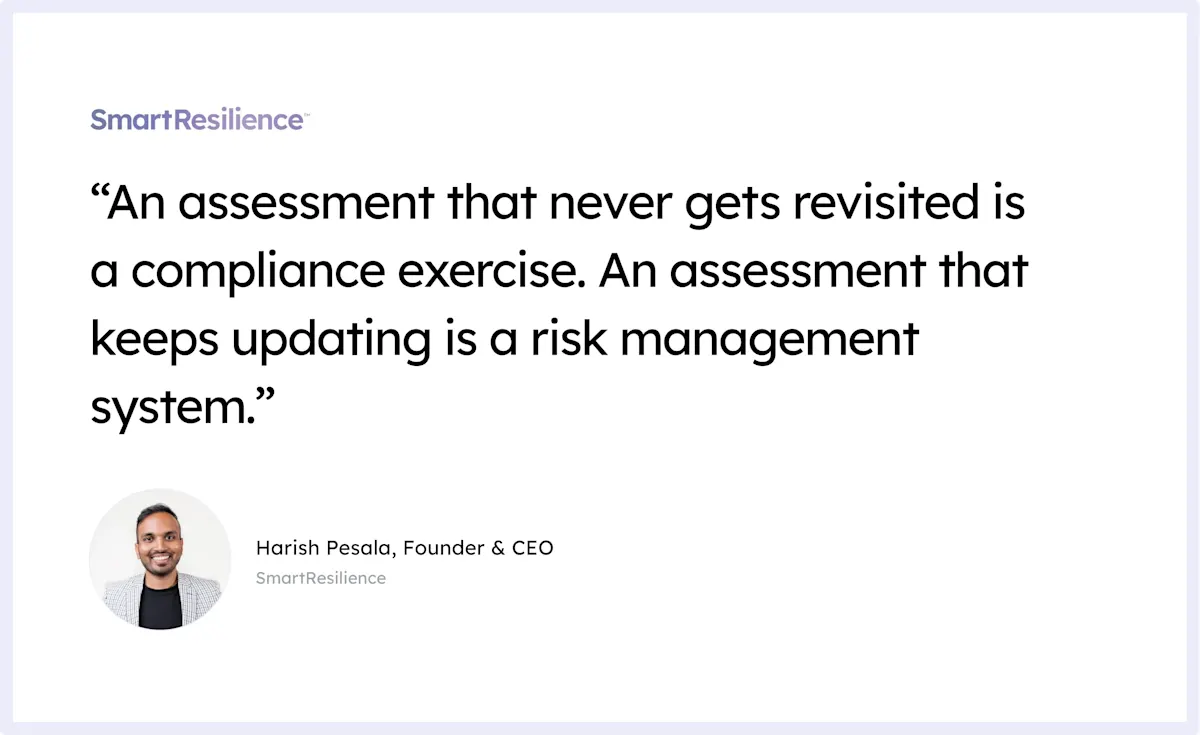
Key takeaway: An assessment that never gets revisited is a compliance exercise. An assessment that keeps updating is a risk management system.
How do you keep the climate risk assessment current as regulations change?
You keep a climate risk assessment current by treating monitoring as an ongoing part of the process, not a project you revisit only when a new regulation lands. Three actions keep it live:
Build the assessment on a platform that updates automatically. SmartResilience Monitoring ingests new site data and hazard models continuously, so the numbers don't need a fresh consultancy engagement every time a framework changes.
Track the regulatory calendar as it moves, not just at renewal. UK-regulated businesses face the UK SRS S2 physical risk evidence deadline arriving in 2027, and organisations that have only produced a point-in-time TCFD disclosure will need a quantitative evidence base they don't currently have. See our guide on type: entry-hyperlink id: 3zm26isp0KaJVq05bphsEG.
Re-run scenario analysis whenever the portfolio changes. A site acquired, sold or newly exposed to a hazard shifts the exposure the original assessment modelled, so scope needs revisiting on that trigger, not on a fixed annual schedule.
How do you translate a climate risk assessment into language finance will act on?
You translate it by leading with a figure, not a rating. When a CFO reads a risk score rated high, they still don't know what to budget for. An annualised loss figure, or the projected cost of a specific adaptation measure set against the loss it prevents, gives finance something to approve or reject. One FTSE 100 client used exactly this shift to move its climate reporting from a black box nobody outside sustainability could interpret to a transparent, audit-ready evidence base finance could act on directly. Read the type: entry-hyperlink id: w77ePdqOYpl8DsBrmeKsI for how that translation worked.
For a deeper methodology read our guide on the Physical Climate Risk Appraisal Methodology (PCRAM): a standardised, recognised framework for physical climate risk.
What does an operationalised climate risk assessment look like in practice?
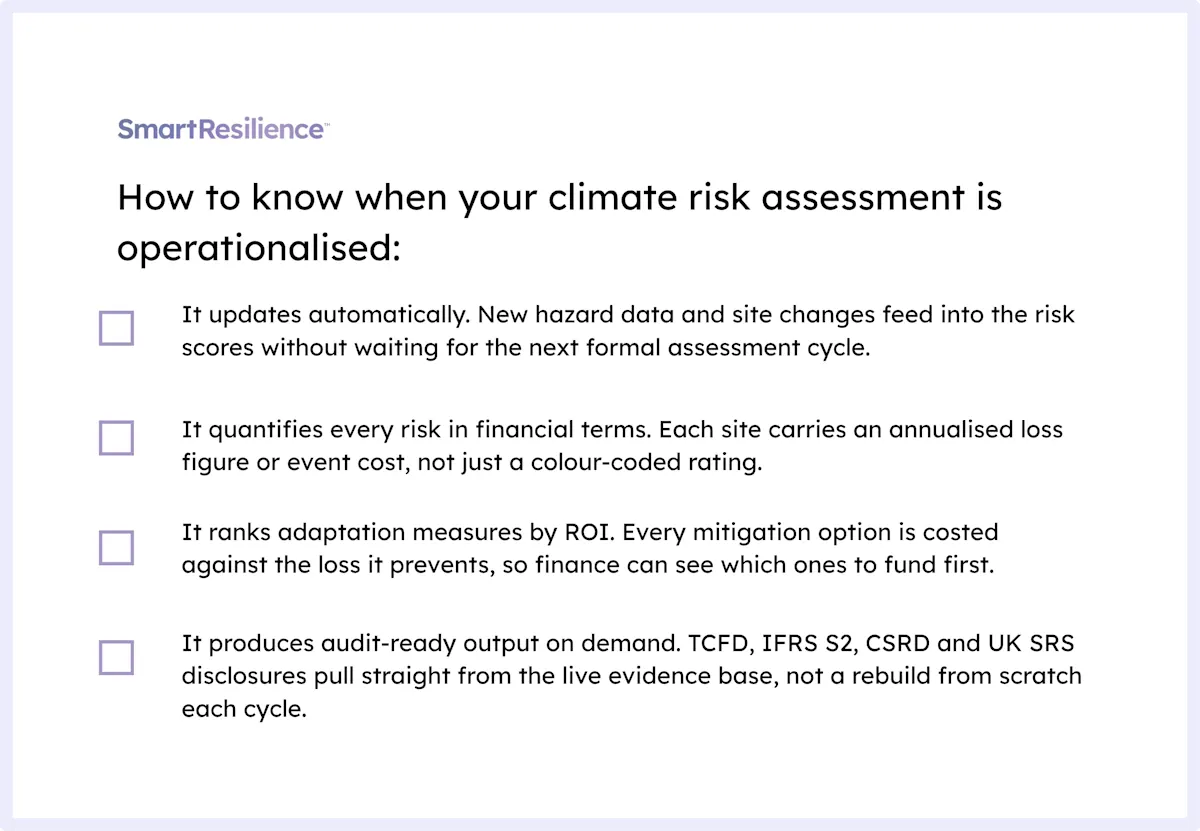
An operationalised climate risk assessment looks like a platform your team checks between reporting cycles, not a PDF opened once a year. Four criteria separate an operationalised assessment from a static one:
It updates automatically. New hazard data and site changes feed into the risk scores without waiting for the next formal assessment cycle.
It quantifies every risk in financial terms. Each site carries an annualised loss figure or event cost, not just a colour-coded rating.
It ranks adaptation measures by Return on Investment (ROI). Every mitigation option is costed against the loss it prevents, so finance can see which ones to fund first.
It produces audit-ready output on demand. TCFD, IFRS S2, CSRD and UK SRS disclosures pull straight from the live evidence base, not a rebuild from scratch each cycle.
SmartResilience Climate Assessments and SmartResilience Monitoring are built to meet all four. Climate Assessments turn the five-stage process above into that audit-ready output, complete with financial damage estimates and ROI-ranked adaptation measures. Monitoring then keeps it live, so your team sees which sites have moved risk tier and which measures now pay for themselves as new hazard data comes in.
Working this way, a compliance officer stops re-explaining last year's numbers to finance every time a framework updates, and starts pointing to a live evidence base that already reflects the current portfolio.
SmartResilience
See SmartResilience in action
Book a free demo tailored to your organisation and assets.
Book a free demoFrequently asked questions (FAQs)
What is a climate risk assessment?
A structured process that identifies, quantifies and prioritises the physical and transition risks climate change poses to a business's sites, supply chain and investments, producing evidence for both internal decisions and regulatory disclosure.
What's the difference between physical and transition risk?
Physical risk is direct damage to assets from events like floods and storms, or long-term shifts like heat and water stress. Transition risk is the cost of moving to a low-carbon economy: new regulation, changing markets and shifting asset values. See our detailed breakdown.
How often should a climate risk assessment be updated?
Continuously, not annually. Hazard models, portfolio changes and regulatory requirements all move faster than a yearly review cycle. Treat monitoring as part of the assessment rather than a separate project scheduled for next year.
What happens after a climate risk assessment is complete?
In most organisations, nothing. The report satisfies the immediate compliance need and then goes stale. The organisations that get value from the exercise turn the output into a continuously monitored capability instead.
Does a climate risk assessment satisfy CSRD, TCFD or UK SRS on its own?
A one-off assessment can satisfy a single reporting cycle, but each of these frameworks expects updated, auditable evidence over time. A static assessment will need to be repeated from scratch unless it is built on a platform that updates continuously.
Who should own the climate risk assessment process internally?
Sustainability or compliance typically initiates it, but the output only creates value once finance and operations are using it too. Assign a named owner and a route for findings to reach the board, not just the sustainability function.
How long does a climate risk assessment take to complete?
A one-off consultancy assessment typically takes several months per cycle. A platform-based assessment can run in weeks for the initial baseline, then updates continuously without repeating the full engagement each time.