

The Task Force on Climate-related Financial Disclosures (TCFD), the EU's Corporate Sustainability Reporting Directive (CSRD) and the UK Sustainability Reporting Standards (UK SRS) all surface in the same compliance conversation, but they sit at different levels: one is a disbanded framework, one is an EU law, and one is the UK's own reporting standard. A compliance team preparing for 2027 needs to know precisely which applies, what changes if the company already reports under an older framework, and where the three genuinely converge.
What is the difference between UK SRS, CSRD and TCFD/IFRS?
UK SRS, CSRD and TCFD/IFRS differ in who defines them, whether that definition carries legal force today, and which companies each one reaches. These differences are wide enough that no single global standard could stand in for all three.
Who defines it, and why a global baseline still needed local versions:
IFRS S1/S2 is the global baseline the ISSB set after absorbing TCFD's four-pillar structure in 2023, but a global baseline only takes effect once a jurisdiction adopts it; UK SRS is the UK's own adoption of that baseline, while the EU chose not to adopt IFRS S2 and built CSRD on its own European Sustainability Reporting Standards (ESRS) instead.
Whether it currently carries legal force:
TCFD fulfilled its remit and disbanded in October 2023, so it no longer exists as something a company can newly align to; UK SRS, covering UK SRS S1 for general sustainability and UK SRS S2 for climate, stays voluntary until a mandatory date is confirmed; CSRD, unlike either, is already binding EU law today, so a UK compliance team is not weighing three equally live obligations.
Which companies it reaches:
UK SRS reaches a company through a UK listing, while CSRD is EU law that only reaches a UK company through indirect routes such as an EU parent or a qualifying EU subsidiary, routes that rarely overlap with a UK listing.
Despite those differences in origin and legal status, the underlying evidence overlaps enough that duplication isn't necessary: the IFRS Foundation and the European Financial Reporting Advisory Group's (EFRAG) interoperability guidance maps ESRS climate disclosure closely onto IFRS S2, so a company already reporting under CSRD can carry most of that evidence into UK SRS S2 rather than rebuilding it, easing the load for groups that disclose in more than one jurisdiction.
What happened to TCFD, and is it still a live standard to align to?
TCFD is not a live standard as it disbanded in October 2023, and the IFRS Foundation took over monitoring corporate climate-disclosure progress from 2024 as the International Sustainability Standards Board's (ISSB) IFRS S1 and S2 standards rolled out. The voluntary framework itself is gone, but the UK's Climate-related Financial Disclosure (CFD) Regulations already require TCFD-aligned disclosure from large UK companies and LLPs with more than 500 employees, in force since April 2022 and staying mandatory until UK SRS S2 supersedes it.
How does UK SRS S2 compare to IFRS S2?
UK SRS S2 and IFRS S2 both carry TCFD's four-pillar architecture forward into current practice, even though a company can no longer newly adopt TCFD itself as a voluntary framework. A company already aligned to all eleven of TCFD's original recommended disclosures, whether by choice or under the CFD Regulations, has much of this foundational structure in place for both UK SRS S2 and CSRD's climate chapter (ESRS E1), even though CSRD layers double materiality on top:
Governance: UK SRS S2 and IFRS S2 both expect a board-level description of oversight, the same starting point TCFD set out.
Strategy: Both standards ask for climate risks and opportunities integrated into strategy and financial planning, extending TCFD's original scenario-analysis expectation.
Risk management: Both require a documented process for identifying, assessing and managing climate risk, again inherited from TCFD's structure.
Metrics and targets: Both call for quantified metrics and targets, though UK SRS S2 pushes further with a specific physical-risk financial metric TCFD never mandated.
How do UK SRS, CSRD and TCFD/IFRS compare on materiality, scope and legal status?
The single biggest structural split between the three is materiality: UK SRS and IFRS S1/S2 both use single, financial materiality, while CSRD's ESRS require double materiality covering financial impact and societal or environmental impact. See the table below for the detailed breakdown:
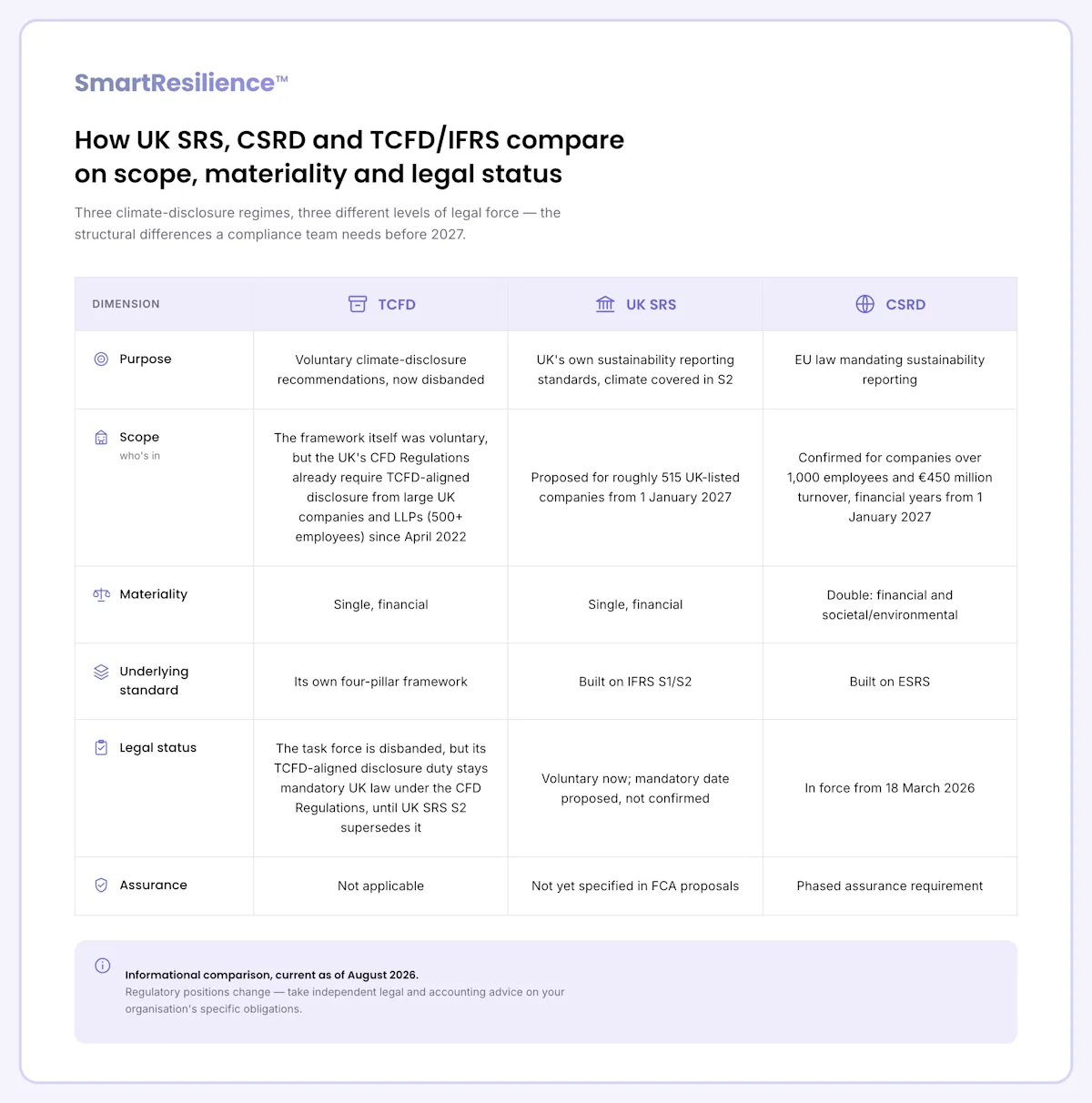
CSRD's ESRS also mandate a standardised set of datapoints once a topic is material, while UK SRS and IFRS S2 leave the reporter to define both materiality and the specific metrics that follow from it. The underlying evidence usually ends up similar either way, but CSRD produces more directly comparable disclosures across companies.
Post-Omnibus CSRD and proposed UK SRS S2 now converge on the same effective point: financial years starting 1 January 2027. Reaching that date took very different scope-narrowing processes on each side, confirmed from opposite sides of the Channel by the Financial Conduct Authority's (FCA) CP26/5 consultation and the Council of the European Union's Omnibus announcement. The Financial Reporting Council's (FRC) FAQ on sustainability reporting developments confirms UK SRS remains voluntary pending the FCA's autumn 2026 policy statement.
Key takeaway: CSRD's new thresholds are already in force; UK SRS's 2027 mandatory date is still a proposal awaiting the FCA's autumn 2026 policy statement.
Does CSRD apply to a UK company?
CSRD has no direct legal effect in the UK after Brexit, but a UK company can still be pulled into scope indirectly:
As an EU subsidiary: A UK company owned by an in-scope EU parent typically reports at the group level, and the UK subsidiary's data usually feeds into that group report.
As a third-country undertaking: A UK parent generating more than €450 million in EU-wide turnover through an EU branch or subsidiary above €50 million turnover falls into scope directly as a non-EU undertaking.
Through a customer or investor's value chain: A UK supplier to an in-scope EU company often receives sustainability data requests even without being legally in scope itself.
A company that finds itself in either of the first two categories should confirm its position with its own legal and accounting advisers rather than relying on a general rule. Landing in CSRD scope does not mean starting UK SRS S2 evidence from zero: the same interoperability guidance mapping ESRS onto IFRS S2 carries most of that work across, easing the load for a company confirmed in scope for both.
If a company already reports under TCFD, what changes under UK SRS?
If your company already reports under TCFD, you should expect UK SRS S2 to keep its four-pillar structure, governance, strategy, risk management and metrics and targets, but to demand more within each pillar:
Explicit risk classification: UK SRS S2 requires physical and transition risks classified separately, where TCFD left the split largely to the reporter's discretion.
A vulnerable-assets figure: UK SRS S2 asks for a financial figure tied to the assets most exposed to climate hazards, a level of granularity TCFD never mandated.
Closer links to the financial statements: UK SRS S2 pushes climate disclosures closer to the numbers in the annual report, so finance teams get pulled in earlier than they were under TCFD-era reporting.
Meeting these three demands well takes time. Teams need asset-level data that most TCFD-era reporting never collected, and they need finance and strategic leaders involved earlier than TCFD-era reporting required. A company with TCFD-era reporting already in place has a head start on structure, not on the underlying data.
What does a company actually need to produce, regardless of which standard applies?
A company needs to produce the same physical-risk evidence regardless of which standard applies: site-level hazard exposure, quantified financial effects and acute versus chronic categorisation. Strip away the differing materiality lenses and legal mechanics between TCFD-era reporting, UK SRS and CSRD, and this evidence is functionally the same input across all three:
Site-level hazard exposure: Every framework expects a company to know which sites face which hazards, whether the output is called a TCFD scenario analysis, a UK SRS S2 physical-risk metric or a CSRD climate chapter (E1) disclosure.
Quantified financial effects: Each framework eventually asks for a number, an annualised loss, a probable maximum loss or a comparable financial figure, not just a hazard rating.
Acute versus chronic categorisation: Every framework separates one-off events like flooding from slow-moving pressures like water stress, because the two carry different planning implications.
IFRS S2 and its predecessor TCFD were both built around resilience: quantifying and managing physical risk properly is the point, and the disclosure is what falls out the other end. Producing that evidence as proof of resilience rather than a compliance artefact makes it easier to fund, because leaders engage with a resilience question far more readily than a compliance one, and the same evidence still satisfies whichever disclosure framework applies.
Practical tip: Build the site-level hazard and financial-effects dataset once, on a documented methodology, so it can be repackaged for whichever framework ends up mandatory rather than rebuilt from scratch.
How SmartResilience helps you build one evidence base for UK SRS, CSRD or TCFD-era reporting
SmartResilience builds one auditable physical-risk evidence base that maps to UK SRS S2, CSRD's climate disclosures and legacy TCFD-era reporting alike, so teams never rebuild it per framework. Most compliance teams reach the same wall once they compare the three side by side: the underlying physical-risk evidence is identical, but the reporting mechanics differ every time. SmartResilience Climate Assessments, IFRS S2 aligned and UK SRS-aligned, build that evidence base once:
One site-level dataset: SmartResilience quantifies physical hazard exposure and financial effects at site level, mapped to UK SRS S2's vulnerable-assets and financial-effects requirements and to CSRD's climate risk and resilience disclosures alike.
A refreshed baseline, not a rebuild: SmartResilience updates the same underlying dataset continuously, so a change in which framework becomes mandatory does not mean starting the evidence-gathering again.
An auditable methodology: SmartResilience documents the methodology and data lineage behind every figure, so the same evidence base holds up whichever framework's auditor tests it.
Meadow, a UK dairy, confectionery and plant-based ingredients business running five sites and £500 million in turnover, adopted this approach partly to secure Environmental Permits from the Environment Agency. “The SmartResilience platform was easy to use, fast and thorough. Their one click climate resilience reporting and longer-term climate resilience mapping is a no-brainer for any business with multiple sites, especially food businesses like ours,” says Alun Lewis, Head of Sustainability at Meadow.
SmartResilience
See SmartResilience in action
Book a free demo tailored to your organisation and assets.
Book a free demoWhat should a company do while UK SRS and CSRD are changing?
A company should treat the underlying physical-risk evidence, not either framework's current wording, as the constant while UK SRS and CSRD keep changing.
CSRD's scope just narrowed sharply, and UK SRS's mandatory date is still a proposal, not a confirmed rule. Both will keep moving as the FCA's policy statement and any future Omnibus adjustments land. Treating the underlying physical-risk evidence as the constant, rather than the framework, is what keeps a compliance programme steady through whichever version of the rules eventually applies. Organisations should take independent legal and accounting advice on their specific reporting obligations before finalising any disclosure.
FAQs
Is UK SRS the same as CSRD? No. UK SRS is a UK standard built on IFRS S1/S2, while CSRD is EU law using its own ESRS standards; a UK company can be affected by one, both or neither depending on its structure and where it operates.
Does CSRD apply to UK companies? CSRD has no direct effect in the UK, but a UK company can fall into scope indirectly, most often as the UK subsidiary of an in-scope EU parent or as a non-EU undertaking exceeding CSRD's EU turnover thresholds.
What is the difference between single and double materiality? Single materiality asks only how climate risk affects a company's finances. Double materiality, which CSRD's ESRS require, also asks how the company's own activities affect the environment and society.
What happened to TCFD? TCFD disbanded in October 2023 after fulfilling its remit, and the IFRS Foundation took over monitoring climate-disclosure progress from 2024 as the ISSB's IFRS S1 and S2 standards rolled out.
What changes if a company already reports under TCFD? The four-pillar structure carries over, but UK SRS S2 adds explicit physical and transition risk classification, a vulnerable-assets financial figure and closer links to the financial statements.