When a climate risk platform purchase spans sustainability, facilities, finance and insurance, procurement usually asks for a formal request for proposal (RFP). Most RFP guidance in this category was written for banks and asset managers, so corporate teams end up adapting questions about loan books to a network of stores, plants and distribution centres. This guide is for larger organisations that select vendors through an RFP, and it follows the process in the order you will need it: what the document contains, then the panel, the timeline, the requirements, the pilot, the scoring and the contract.
What is the difference between an RFP and an RFI?
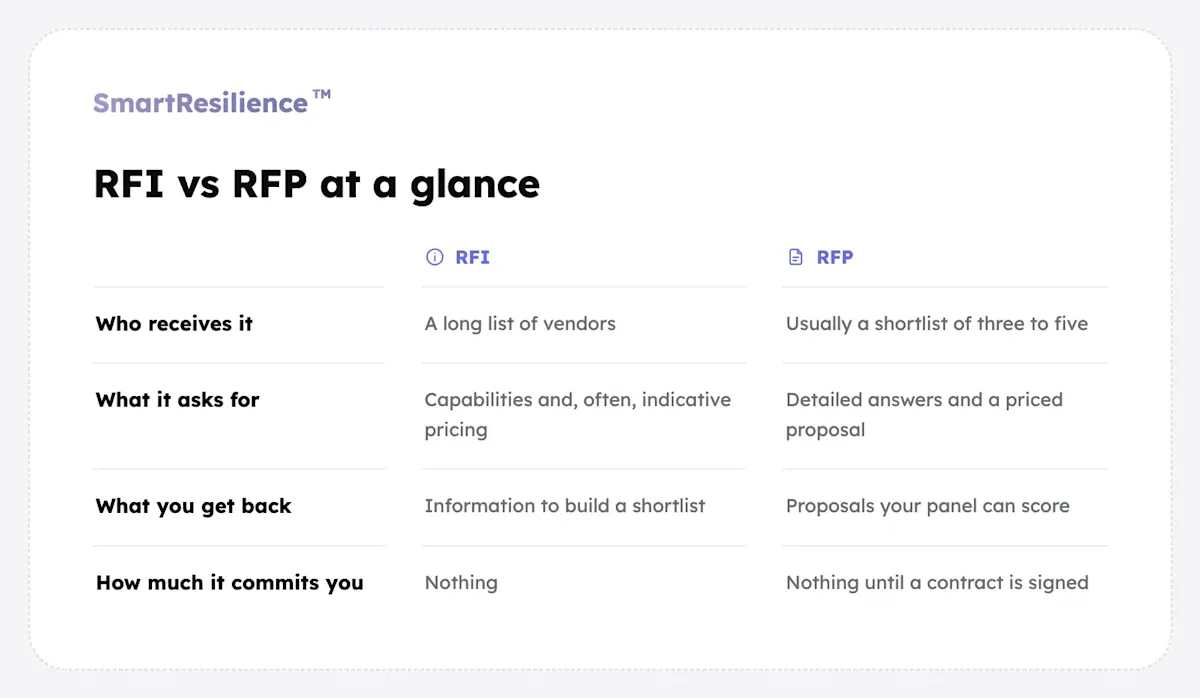
The difference between an RFP and a request for information (RFI) is purpose and depth: an RFI gathers capabilities and indicative pricing from a long list of vendors to build a shortlist, while an RFP asks that shortlist to answer detailed requirements on the same terms so your panel can score them and choose one. An RFI usually comes first and can be enough on its own when the need is narrow, such as a single hazard across a few sites. A full RFP fits when several functions must agree on one platform and your procurement policy requires comparable, scored responses.
One decision sits before either document. If your team has not yet settled on choosing between a climate risk consultant and a software platform, resolve that first, because the two are bought in very different ways.
What should a climate risk RFP include?
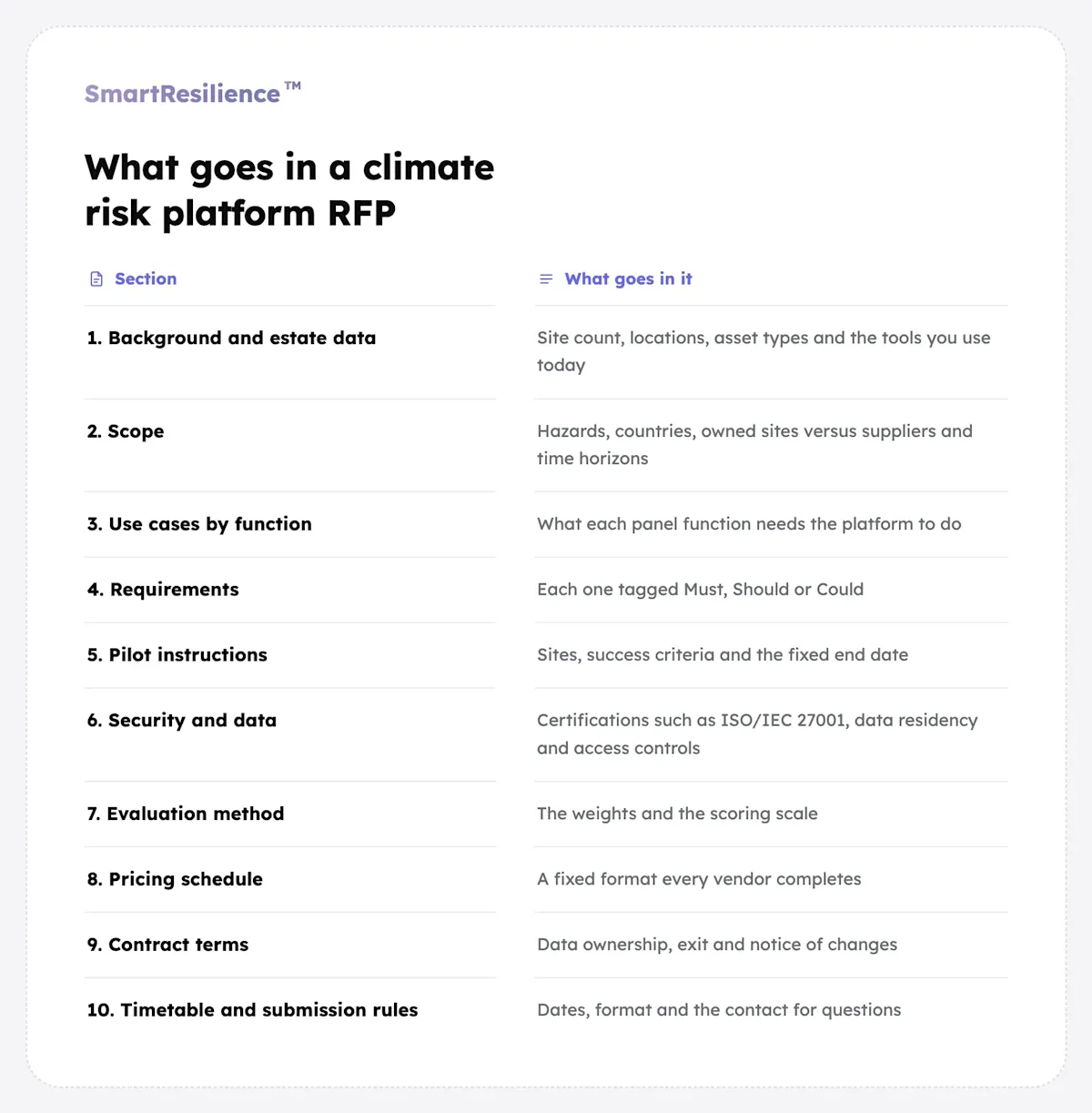
A climate risk RFP should include your estate data, scope, requirements, pilot instructions, evaluation method, pricing schedule and contract terms, set out in ten sections so every vendor answers in the same format. Name the climate scenarios and time horizons your existing scenario analysis uses, so each vendor confirms it can run the same ones and your results stay comparable year on year. Tag each requirement as Must, Should or Could, so vendors know which ones decide the outcome.
For the questions to put inside the requirements section, the eight questions to ask before you buy climate risk management software cover hazard coverage, financial outputs, data lineage and integrations in detail.
Does company size change whether you need a full RFP?
Company size decides whether you need a full RFP: a large organisation with many sites and several functions involved usually does, while a smaller one with a single team owning the decision can often shortlist, trial and decide without one. The difference comes down to how many people must agree on the outcome, since a group where five functions rely on the same platform needs a process each of them can see is fair.
A full RFP usually fits when:
Your estate runs to hundreds of sites or spans several countries.
Several functions, such as facilities, finance and insurance, each own part of the outcome.
Your procurement policy sets a contract value above which a formal tender is required.
The platform's outputs will feed group-level climate disclosure.
Smaller organisations with a handful of sites can usually shortlist from published comparisons of climate risk management software, run demonstrations and a short trial, and decide without a formal RFP. The rest of this guide covers the larger case.
Who should sit on the evaluation panel for a climate risk solution?
The evaluation panel for a climate risk solution should include representatives from sustainability, facilities, finance, insurance, procurement and information technology (IT), with each person scoring only the sections their function owns. Specialists then judge the sections they know best, and every function can see its stake in the result.
What each function scores:
Sustainability: Disclosure outputs and audit readiness are scored by the sustainability or reporting lead.
Facilities and property: Site managers judge early warnings and adaptation measures.
Finance and risk: Finance assesses the loss figures and cost-benefit evidence.
Insurance: The insurance manager checks whether outputs would help at renewal.
Procurement and IT: Procurement covers commercials and contract terms, while IT reviews data handling and security.
Name one panel owner, usually the sustainability or risk lead sponsoring the purchase, who settles disagreements about weights and scope.
Practical tip: Agree the scoring weights and record them before the first response arrives. Weights that change after vendors respond tend to follow a favourite rather than the requirements.
How long should you plan for the procurement?
A climate risk platform procurement typically takes four to six months from the first requirements workshop to a signed contract. The one public, dated example in the UK sits inside that range: the National Wealth Fund published a preliminary market engagement notice for its Climate Physical Risk Assessment Services tender on 17 March 2026, a tender notice on 1 June 2026 and a contract details notice on 19 August 2026, roughly five months end to end.
Build your plan around five stages:
Requirements: The panel agrees scope, use cases and scoring weights, which typically takes three to four weeks.
RFI and shortlist: Procurement sends the RFI to a long list and narrows it to three to five vendors over three to four weeks.
RFP responses: Shortlisted vendors usually need three to four weeks to answer in full.
Pilot: The two or three strongest vendors assess your sites over a fixed period agreed with them in advance.
Scoring and contract: The panel scores responses and pilot results while procurement and legal negotiate, which often takes four to six weeks.
Public bodies often need longer, because formal tender rules add notice periods. Allow extra time if your legal team reviews data-processing terms separately.
Which requirements test what a platform does after the assessment?
The requirements that test what a platform does after the assessment are those on site alerts, adaptation measures, data updates and evidence for insurers. An RFP written only for disclosure tends to leave them out. Sustainability teams file a disclosure once a year. Facilities, finance and insurance teams need the same assessment to inform decisions in between, such as which sites receive flood defences in this year's capital plan.
Requirement lines you can copy into the RFP:
"Describe how an alert reaches a named site contact, and provide an example alert log."
"Show how adaptation measures are ranked by cost and benefit for one of our pilot sites."
"Describe how outputs update when we add or retire a site, and how long the update takes."
"Describe the evidence your platform produces for our insurer at renewal, with an example."
An assessment refreshed every one to two years can fall behind an estate that changes every quarter. When your panel asks how outputs update, it learns whether the platform will keep pace with acquisitions, closures and refurbishments across a large UK estate.
Which requirements test methodology and audit readiness?
Requirements on methodology and audit readiness should cover data inputs, scenarios, time horizons, assumptions, resolution and disclosure alignment, so your auditor and board can trace how every figure was produced. When the National Wealth Fund tendered for physical climate risk services in 2026, it asked suppliers for a "robust, transparent and auditable methodology", with the data sources, assumptions and limitations documented.
Get clear, written answers on:
Methodology and data inputs: Each vendor should show which data sources feed its models and how each figure traces back to them, including the model version that produced it.
Scenarios and time horizons: Each vendor should name the scenario sets it offers, such as the Intergovernmental Panel on Climate Change (IPCC) Sixth Assessment Report (AR6) pathways or the Network for Greening the Financial System (NGFS) scenarios, and let your team set horizons to its own planning years.
Assumptions and limitations: Each vendor should state the key assumptions behind its models and where the data is weaker, for example in countries with sparse records.
Resolution: Each vendor should state the grid size of its hazard models, typically between 5 m and 30 m. A 5 m grid shows how a flood would affect different parts of one site, which some teams need and others find more detail than they use.
Disclosure and assurance: Outputs should map to International Financial Reporting Standards (IFRS) S2, the climate standard issued by the International Sustainability Standards Board (ISSB), and to UK Sustainability Reporting Standards (UK SRS) S2, with documentation that matches what assurers ask for on physical climate risk.
Scenario sets do change. The NGFS has noted that the academic paper behind its Phase V physical damage estimates has been retracted. It plans an updated methodology for its next long-term scenarios, due at the end of 2026, so each vendor's answer on handling such changes carries real weight.
The UK Government finalised UK SRS S1 and S2 in February 2026 for voluntary use, and it will consider with the Financial Conduct Authority (FCA) whether to require certain UK entities to report against them. Take independent legal and accounting advice on your organisation's specific obligations.
How do you run an initial pilot with shortlisted vendors?
An initial pilot works best when the two or three strongest vendors assess the same 15 to 20 of your own sites, against criteria and an end date agreed in advance. Vendors often disagree on the same asset: in a Global Association of Risk Professionals benchmark of 13 vendors, published through the regulator-convened Climate Financial Risk Forum, one property was rated highly exposed to flooding by one vendor and not exposed by another.
Set the pilot up on these terms:
Give every vendor the same test sites: Include a riverside site, an overseas site and one that flooded recently, such as a distribution centre with a known claim, so your team can check results against what happened.
Agree how you will judge results before you start: Compare whether each vendor places your sites correctly, how its hazard ratings and resolution show risk at each site, how well it explains its outliers and whether a test alert reaches the right person.
Fix the scope and the end date: When every vendor works to the same deadline, none of them gains extra weeks to polish its results.
Decide whether to pay for the pilot: A paid pilot tends to secure more vendor effort, while an unpaid one keeps your options open.
Agree what happens to your data afterwards: Put in writing that your site data is returned or deleted if you do not proceed.
How should you score RFP responses and pilot results?
RFP responses and pilot results are easiest to compare when Must requirements act as pass or fail gates and every other requirement is scored from 0 to 5 against weights the panel agreed in advance. Weight pilot results, disclosure readiness and financial quantification with adaptation return on investment (ROI) highest, at around 15% each, and let each function score only its own sections.
How is climate risk software priced, and what should the contract cover?
Climate risk software is usually priced per site or asset, per licence or per engagement, and the contract should fix how that price changes with your estate, who owns your data and how you exit. Few vendors in this category publish their rates, and data licensing, refresh costs and implementation are often quoted separately, so ask every vendor to price the same scenarios in your RFP's fixed format.
Price lines to include in the schedule:
Your current estate, per site and in total, over the full contract term
Adding 50 sites mid-contract, and removing sites after a disposal
Annual refreshes and any data-licensing fees
Implementation, onboarding and training for each panel function
In the contract, set out:
Who owns your site data and the outputs produced from it
How your data and outputs are exported if you leave
How much notice the vendor gives before changing its methodology or scenario sets
Service levels for alerting, if your organisation buys monitoring
How SmartResilience helps you meet the requirements in a climate risk RFP
The requirements in a well-run RFP focus on two things: a transparent methodology at a resolution that suits your sites, and outputs your teams can act on after the report is filed. SmartResilience Climate Assessments and SmartResilience Monitoring and Early Warning work together to meet both, and the team works alongside your panel as a long-term partner:
Site-level figures you can test: The platform reports average annual loss (AAL) and climate value at risk (CVaR) for each site, under multiple emissions scenarios and any horizon to 2100.
Adaptation measures ranked by return: Your facilities and finance teams see measures from an engineering library ranked by ROI for each site.
Alerts that reach a named person: Site teams receive tiered alerts by SMS, email and dashboard with site-level runbooks, and every alert and response is logged as evidence for insurers.
A methodology your auditor can follow: Transparent assumptions, full data lineage and auditable change logs sit behind every figure, with IFRS S2 aligned outputs.
An estate that can change: Your team adds or retires sites on demand, and outputs update continuously.
A FTSE 100 manufacturer rolled the platform out across 53 countries in 6 weeks and reduced its climate risk analysis costs by more than 50% against its previous provider. Sainsbury's runs early warning across 1,000+ sites and, with 12 hours' notice of a flood, avoided a £3m loss.
SmartResilience
See SmartResilience in action
Book a free session tailored to your organisation and sites.
Book a free sessionWhat should your climate risk evaluation panel decide first?
Your evaluation panel's first decision is what triggered this purchase, whether a disclosure deadline, a recent weather loss or an insurance renewal, because the answer sets your weights before any vendor is contacted. For most large multi-site organisations, the default from there is an RFI to three to five vendors, then an RFP with a pilot for the strongest two or three.
FAQs
How long should vendors have to respond to a climate risk RFP?
Three to four weeks is a common response window for a climate risk RFP. Shorter windows tend to produce generic answers, while longer ones slow the whole procurement. Hold one clarification session early in the window, so every vendor hears the same answers to the same questions.
How many vendors should receive a climate risk RFP?
Three to five vendors is a workable number for most panels. More than five makes scoring slow, and it makes a pilot on your own sites hard to run fairly, because each vendor needs the same data, time and support from your team.
What security standards should a climate risk solution meet?
Most buyers ask for certification to ISO/IEC 27001, the international information security standard, or a System and Organization Controls (SOC) 2 report, plus data residency that meets the General Data Protection Regulation (GDPR). Ask for current certificates rather than statements, and check who can access your site data inside the vendor.
Can public bodies run a climate risk RFP as a formal tender?
Public bodies in the UK publish notices for this kind of procurement on Find a Tender, as the National Wealth Fund did in 2026. Formal tender rules add notice periods and evaluation requirements, so your legal or procurement team should confirm which rules apply.
Does a climate risk RFP need to cover transition risk?
A climate risk RFP should state its scope explicitly. Many platforms in this category lead on physical risk, such as flood and heat, while transition risk covers policy, market and technology change. If you need both, say so and score each separately.
Should the pilot be paid?
A paid pilot tends to secure more vendor effort and a clearer commitment on both sides. An unpaid pilot keeps your options open but can limit how much work a vendor puts in. Either way, agree the scope, success criteria and end date in writing.