On 22 June 2026 the UK Health Security Agency (UKHSA) issued a red heat-health alert for six regions of England, only the second red alert since the system began. For an estate team running hundreds of care homes, hotels or pubs, the alert raised a practical question that morning: which of our sites will struggle, and what should each one do? Most estates answer it on the day, with no shared plan and no record of what heat cost them last time.
What is heat risk?
Heat risk is the chance that high temperatures harm people, buildings, equipment or day-to-day operations. It comes as acute heatwaves lasting a few days and as chronic warming that makes each summer hotter on average. Summer 2025 was the warmest UK summer on record, with a provisional mean of 16.10°C according to the Met Office.
How does heat risk affect UK businesses with many sites?
Heat risk affects UK businesses with many sites by putting staff and residents under strain, pushing equipment to failure, raising cooling costs and cutting trade, often at many sites in the same week. Each of these effects tends to look small at one site and only becomes significant across an estate:
Staff productivity falls and health risks rise: A 2025 report from the World Health Organization (WHO) and the World Meteorological Organization (WMO) found that worker productivity falls by 2 to 3% for every degree above 20°C, while older or unwell care residents face the greatest health risk.
Equipment fails more often: Refrigeration, IT and kitchen plant work harder in hot weather, which brings more call-outs and stock write-offs.
Cooling costs rise: Sites with air conditioning run it harder, while sites without it often hire portable units at short notice.
Sales and footfall drop: CGA by NIQ found that average sales in managed licensed venues across Britain fell 3.7% year on year in the week to 15 August 2026, and NIQ's UK and Ireland commercial lead said venues without outdoor space "will have found it hardest to attract guests".
Key takeaway: Heat costs land in separate budgets for energy, maintenance, staffing and sales, so few estates ever see what a hot summer cost them in total.
Which sites in an estate are most exposed to heat?
The sites most exposed to heat usually share a building type or an occupant profile rather than a postcode. A care home group and a pub group can run the same triage, and four kinds of site tend to rise to the top.
Older and listed buildings
Older and listed buildings often have limited ventilation and few options for adding cooling without consent. A Victorian pub with a first-floor kitchen is a typical example.
Care settings
Residents who are older or unwell may not be able to move to a cooler room on their own. Research by the Joseph Rowntree Foundation (JRF) found little awareness or preparedness for overheating in care settings, and heat sits alongside flood and water stress in a wider physical climate risk assessment for healthcare.
Sites without mechanical cooling
Pubs, small hotels and older care homes often rely on opening windows, which stops working once the air outside is hotter than the air inside. These sites have no fallback in a long hot spell, so they tend to need a plan before sites with air conditioning.
Hot rooms and hot locations
Top floors, glazed frontages, south-facing rooms, kitchens and plant rooms tend to overheat first, like the top-floor lounge in a 1970s care home. Location adds to this, and a 2026 study by Arup for the Climate Change Committee (CCC) found overheating risk is generally highest in larger cities and the South East.
How can you protect your sites from rising heat?
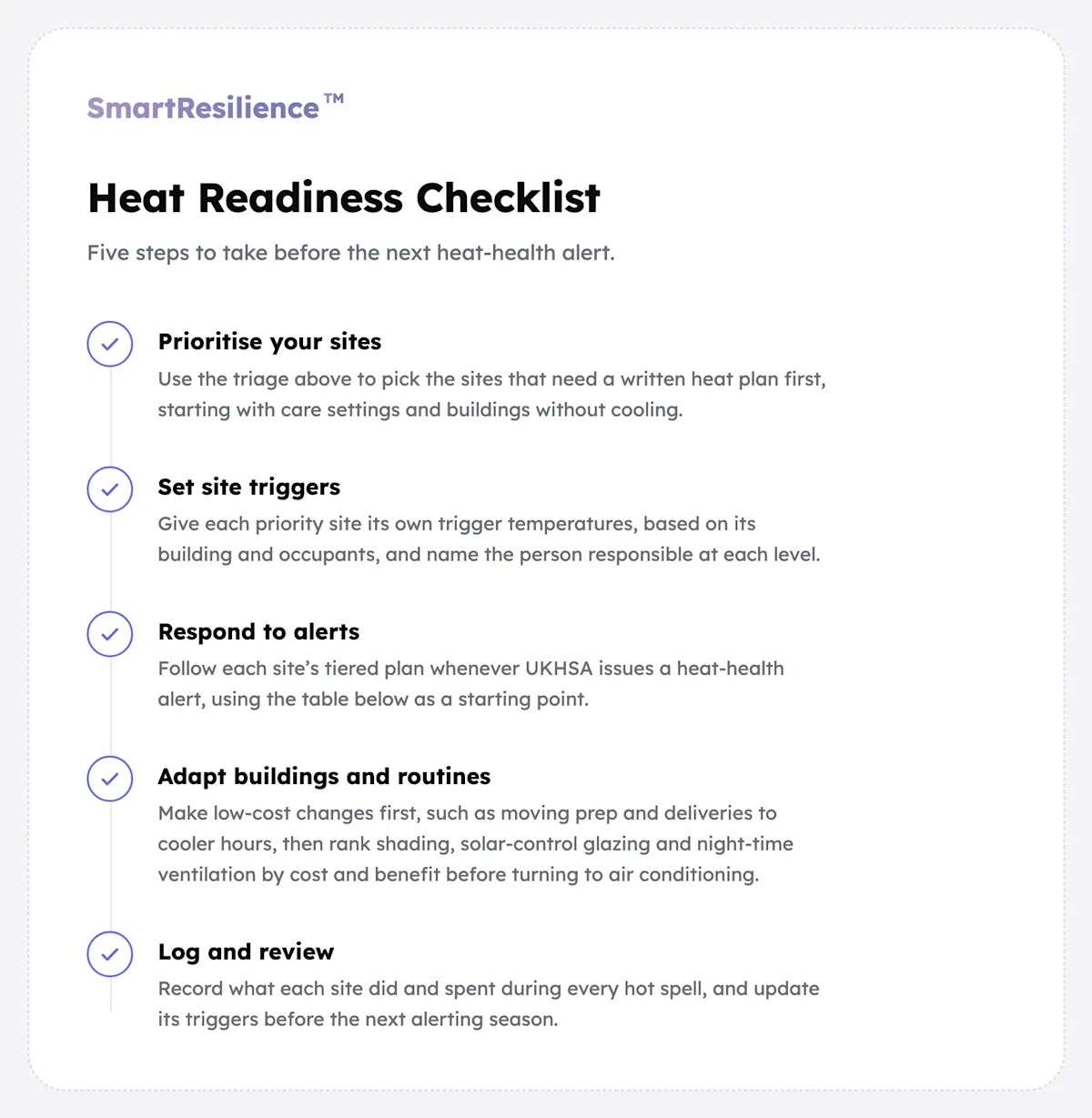
Protecting sites from rising heat is a yearly cycle of five steps, and responding to a heat-health alert is one of them:
Prioritise your sites: Use the triage above to pick the sites that need a written heat plan first, starting with care settings and buildings without cooling.
Set site triggers: Give each priority site its own trigger temperatures, based on its building and occupants, and name the person responsible at each level.
Respond to alerts: Follow each site's tiered plan whenever UKHSA issues a heat-health alert, using the table below as a starting point.
Adapt buildings and routines: Make low-cost changes first, such as moving prep and deliveries to cooler hours, then rank shading, solar-control glazing and night-time ventilation by cost and benefit before turning to air conditioning.
Log and review: Record what each site did and spent during every hot spell, and update its triggers before the next alerting season.
UKHSA heat-health alerts describe expected impacts rather than fixed temperatures, and the core alerting season runs from 1 June to 30 September. A red alert means a severe heatwave could have impacts beyond health and social care, including on transport, energy supplies and businesses. The table shows how one alert translates into different actions at different sites, using illustrative triggers rather than official thresholds.
Alert level | What UKHSA says it means | Example site trigger | Care home actions | Hotel or pub actions | What to log |
|---|---|---|---|---|---|
Yellow | Heat may affect particularly vulnerable people. | The hottest room is forecast above 26°C. | Staff check the cool room, fans and medicine fridges. | Staff check cellar and fridge temperatures. | Indoor temperatures and equipment checks. |
Amber | Health impacts are likely across the wider population. | The hottest room stays above 26°C for two days. | The manager adds staff and keeps medicines below 25°C. | The team moves prep to the morning and closes the hottest rooms. | Extra staff hours and stock written off. |
Red | Life is at risk even for healthy people, and businesses may be affected. | Any red alert covering the site's region. | The manager activates the business continuity plan. | The manager considers reduced hours and checks deliveries. | Trading hours lost and every incident cost. |
How do you prepare older or listed buildings that have no air conditioning?
Older or listed buildings without air conditioning are usually prepared in a sequence: shading and ventilation first, changes to how the site runs next, and more invasive works only with the right consent. Historic England says there is no standard solution for overheating, because each building's construction, use and occupants decide what works. Treat the order below as a starting point rather than a fixed recipe.
Add shading and night-time ventilation first: Teams pair internal blinds with external awnings or shutters where allowed, then open windows at night when the outside air is cooler, which cuts heat gain with little change to the building.
Change how the site runs on hot days: Site teams move heavy work to cooler hours, set up a designated cool room and close the hottest rooms during the afternoon peak.
Cool one safe room where vulnerable people stay: A portable or small fixed unit in one room can keep a safe space when shading and ventilation are not enough.
Get consent before any external works: Some works to a listed building need Listed Building Consent, so teams check with the local planning authority before external shading or new plant goes in.
Can heat risk be quantified financially?
Heat risk can be partly quantified today, though less reliably than flood risk, because most heat losses are operational costs rather than physical damage. Flood losses are usually measured as average annual loss (AAL) and probable maximum loss (PML), metrics that fit damage to buildings and stock. Heat rarely damages the building itself, so its cost appears as energy, absence, write-offs and lost trade.
Methods in use today
Heat models are still maturing across the industry, and their figures depend heavily on their assumptions. Most combine some of these approaches:
Productivity models: Analysts estimate lost output from the number of days above set temperatures, drawing on evidence such as the WHO and WMO finding of a 2 to 3% loss per degree above 20°C.
Revenue adjustments: Some models reduce a site's expected revenue on days above thresholds such as 30°C or 35°C.
Site cost tagging: Finance and facilities teams tag heat-related costs in the systems they already use, so each site's real losses become visible.
Where to start
Real costs from your own sites give finance a number to test any model against. Tagging energy, maintenance call-outs, agency cover and stock write-offs at each priority site for one summer is usually enough to show which sites cost the most.
How SmartResilience helps you manage heat risk across your sites
Most estate teams already receive regional heat alerts. What they need is a way to turn each one into the right action at the right site, and SmartResilience works with your organisation to do that:
Heat threshold alerts for each site: The platform monitors conditions 24/7 and issues heat threshold alerts with escalation protocols, set for each site rather than for a whole region.
Alerts routed to the right people: Tiered alerts reach facilities, operations and risk teams by SMS, email and dashboard, so the person who can act sees them first.
Runbooks in the facilities routine: Each site has an operational runbook, so a site manager knows the steps to take at each alert level.
A record of every response: Every alert and response is logged, which gives your team an evidence trail to share with insurers and the board.
Across the wider platform, SmartResilience Climate Assessments quantify flood exposure at site level and rank adaptation measures by return. SmartResilience already runs across more than 3,500 sites.
SmartResilience
See SmartResilience in action
Book a free demo tailored to your organisation and assets.
Book a free demoWhat should an estate team do before next summer?
The next core alerting season starts on 1 June 2027. Estates that pick their priority sites, set site triggers and start tagging heat costs over the winter will go into it with a plan and a baseline, rather than working it out on the morning of the next alert. The same estate-by-estate approach works for flood, so one plan can cover both hazards.
FAQs
What temperature is too hot to work in the UK?
UK law sets no maximum working temperature. The Health and Safety Executive (HSE) treats heat as a workplace hazard, so employers must assess the risk. The Trades Union Congress (TUC) wants a 30°C limit, or 27°C for strenuous work, and the government told Parliament in June 2026 that HSE will consult on its workplace temperature guidance.
Do you need Listed Building Consent to install cooling or shading?
Listed Building Consent is often needed for works that affect a listed building's character, such as external shutters, awnings or new plant on a facade. Internal, reversible measures such as blinds or portable units often do not need it, but the local planning authority should confirm before work starts.
How should care homes prepare for a heatwave?
UKHSA guidance for social care managers asks them to brief staff on hot weather and business continuity plans before 1 June. It also asks for a cool room or area kept below 26°C, most medicines stored below 25°C and plans for losing power, water or transport.
Which climate hazards matter most for UK businesses?
Flood, heat, wind, water stress and wildfire are the physical hazards most UK assessments cover. Flood tends to cause sudden damage to buildings and stock, while heat builds costs gradually through energy, staffing and trading.
What do amber and red heat-health alerts mean for a business?
An amber alert means health impacts are likely across the wider population, so sites should move to their heightened plan. A red alert signals a risk to life even for healthy people and possible disruption to transport, energy and supplies, so business continuity plans should be ready to run.