
A record of which sites flooded last winter shows where water has reached in a pub or hotel estate. It does not show what weather costs the estate as a whole, from trade lost when heavy rain or a heatwave keeps guests away to a flooded cellar that closes a site for days. Nor does it show which sites to protect first with measures such as flood barriers or extra cooling. A five-step physical climate risk assessment answers both questions, ranking every pub, hotel and restaurant by financial exposure and ending in a plan that the property director and the insurer can each use.
What is a physical climate risk assessment for a hospitality business?
A physical climate risk assessment for a hospitality business is the process of turning physical climate risk into a financial figure for every pub, hotel and restaurant, counting lost trading as well as building damage. A hazard rating and a financial assessment answer different questions, and the difference shows up when finance asks what to do with a rating
What are the five steps for a pub, hotel or restaurant estate?
The five steps for a pub, hotel or restaurant estate are hazard identification, exposure and vulnerability mapping, the survey decision, financial quantification and adaptation planning, run across every site rather than one flooded venue at a time. The UK Climate Change Committee (CCC) gives a reason to treat them as one exercise. Its fourth independent assessment of UK climate risk, A Well-Adapted UK, projects peak river flows up to 45% higher, lasting longer and arriving more often.
Hazard screening: The estates or property team, working with sustainability and risk, screens every site against modelled data for flood, heat, wind and water stress at once, so the results cover every hazard rather than only the floods the business already knows about.
Exposure and vulnerability mapping: The team scores what sits at each site and how badly a hit would hurt it, then names an owner for each exposure.
The survey decision: The team decides where desktop data is enough and where a listed or older building needs someone on site.
Financial quantification: The team converts the findings into a typical-year cost and a severe-event cost per site, including closure.
Adaptation planning: The team ranks permitted measures by return and packages the evidence for finance and the insurer.
To which climate hazards are pubs, hotels and restaurants most vulnerable?
Pubs, hotels and restaurants are most vulnerable to surface water flooding, heat and wind, because each one strikes the part of the site that keeps it trading: the cellar, the kitchen and the outdoor space. Water stress matters less for most UK estates, though hotels with high laundry and guest-room demand feel drought restrictions first.
Surface water and flash flooding
Surface water is the rainwater that pools and runs off before it ever reaches a river, and river flood zones do not show where it collects. The Environment Agency's national flood risk assessment puts around 4.6 million properties in England in areas at risk from surface water alone. On a high street, the cellar is usually the first place to take water, and a cellar holding kegs, gas and cooling plant can close a pub for days.
Heat
Heat is the hazard that pulls hospitality trade in two directions at once. It reaches a site in three ways:
Staff: Kitchens and bars become harder to staff safely on hot days, and the Health and Safety Executive (HSE) states that there is no law for a maximum working temperature, so the duty is to assess heat as a risk at each site.
Guests: Hotel rooms without cooling draw complaints and refunds, and older buildings tend to hold heat overnight.
Trade: Warm days tend to favour sites with gardens and terraces. In extreme heat the pattern is harder to predict, since some guests move to air-conditioned venues while others stay at home, so trading can fall at both.
Wind
Wind damage concentrates on signage, roofs and outdoor structures such as canopies, parasols and garden furniture. Older sites with deferred roof maintenance tend to carry the largest repair bills after a named storm. After a storm passes, that damage turns into business costs:
Closed areas: A loose sign, a damaged canopy or slipped roof tiles can close the entrance or the garden until a contractor makes it safe, often on the busiest days for outdoor trade.
Rooms out of service: Rain getting in through a damaged roof can take hotel rooms off sale and force cancellations while the leak is traced and repaired.
Liability: A falling sign or an unsecured parasol that injures a guest or a passer-by creates a liability claim on top of the repair.
Repair delays: Roofers are scarce in the week after a named storm, so a site can wait days for a repair while paying the cost of being partly closed.
How do you map exposure and vulnerability across a hospitality estate?
Mapping exposure and vulnerability across a hospitality estate means scoring what sits at each site and how badly a hazard would hurt it, then naming who owns each exposure, rather than applying one average to every venue. Exposure and vulnerability are two separate questions. Exposure is what lies in a hazard's path, and vulnerability is what happens when it is hit.
Two pubs on the same high street show why the distinction matters, and the same five questions work for any site in the estate:
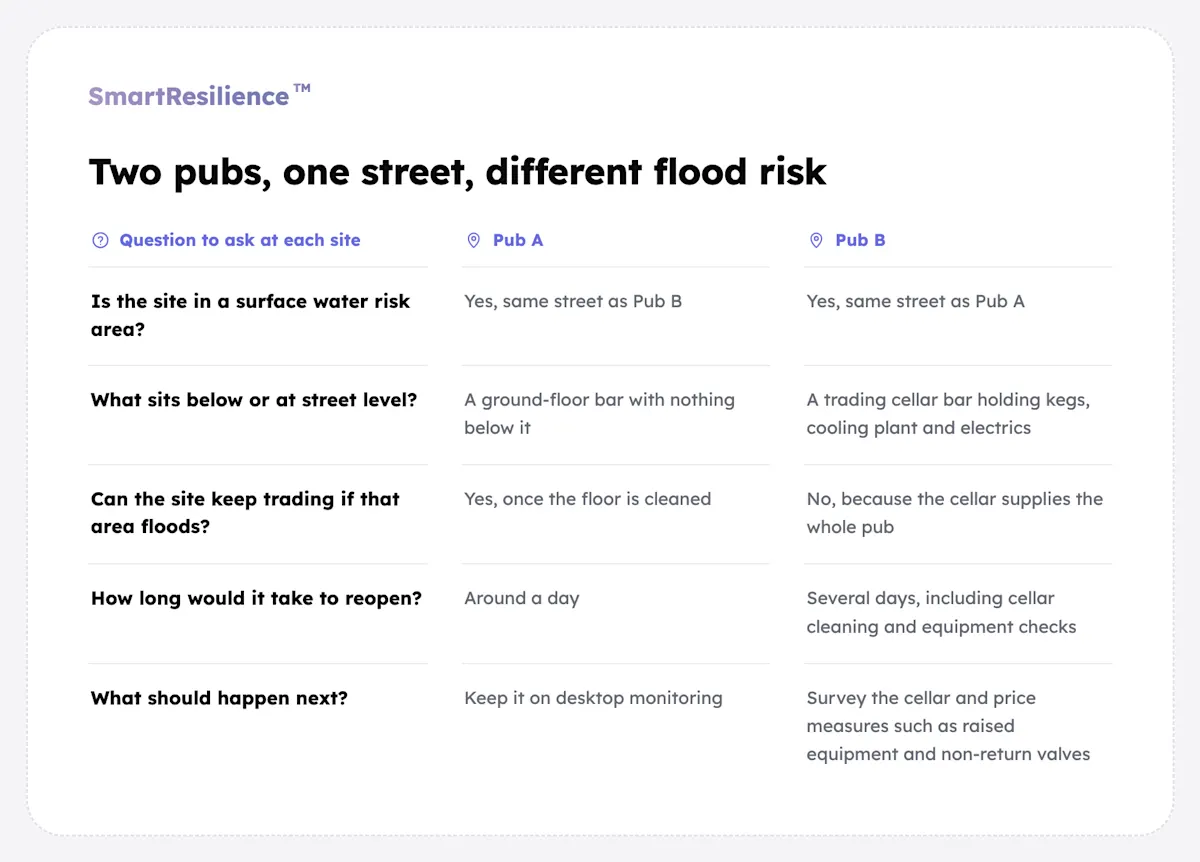
The same logic extends past the building. Overnight guests raise the stakes at a hotel, and a kitchen without spare cooling capacity raises them on hot days. Ingredients and drinks lines carry weather exposure upstream too: the Energy and Climate Intelligence Unit (ECIU) found five weather-hit staples, including butter, beef and coffee, made up about 11% of the UK shopping basket but nearly 40% of food price inflation in 2025.
Name an owner for every exposure
Exposure with no named owner tends to stay unaddressed until the next event. Under many pub leases and tenancies, the responsibility splits three ways:
Building risk: The property owner typically insures and repairs the building, including the structure and the cellar fabric.
Trading risk: The operator or tenant covers contents, stock and loss of trade.
Supplier risk: Procurement owns exposure that sits with a brewery, a distributor or a food supplier.
How do you assess climate risk for listed and older buildings?
Assessing climate risk for listed and older buildings starts with the same desktop assessment as the rest of the estate, then moves to an on-site survey earlier, because the survey has to confirm which measures the building is permitted to have before any of them is costed. A desktop pass ranks every site by modelled exposure. A survey answers what the model cannot, such as the condition of a flood door, the age of a roof or whether cellar equipment can be raised.
Consent is the first difference. Replacing an external door, altering a boundary wall or fitting airbrick covers on a listed building can need listed building consent, so the local conservation officer is an early call rather than a late one.
Construction is the second. Solid walls, lime mortars and timber frames absorb and release water in ways that standard post-flood drying and repair methods can damage. Historic England's Outliers study followed a government-funded flood resilience scheme in Yalding, Kent, that left out listed and timber-framed buildings as unsuitable for retrofitting, and it notes the findings apply to roughly 30% of England's buildings.
Practical tip: Start the survey list with the sites carrying the highest combined exposure and the tightest consent constraints, rather than the venue that flooded most recently.
How do you quantify physical climate risk for pubs, hotels and restaurants?
Quantifying physical climate risk for pubs, hotels and restaurants means putting a figure on every site for a typical year and for a severe event, counting closure days and lost trading as well as building damage. Weather moves hospitality revenue in both directions. In the week to 15 August 2026, during a heatwave, average sales at managed licensed premises across Britain fell 3.7% year on year, according to market researcher NIQ's Daily Drinks Tracker, and Rachel Weller, NIQ's UK and Ireland commercial lead, said venues without outdoor spaces "will have found it hardest to attract guests".
A typical year: average annual loss
An average annual loss (AAL) combines a site's expected damage with its expected lost trading, weighted by how often each event is likely to happen. It gives finance one number per site to set against the cost of a measure. The calculation for a single site follows the same steps in any sector, with trading added to the damage side.
A severe event: probable maximum loss
A probable maximum loss (PML) at a material return period, such as a 1-in-100-year flood, shows what one bad event costs, including every day the site cannot trade. Boards and insurers weigh this figure differently from the annual one, since an insurer's excess is usually set against an event of similar severity.
What to count as lost trading
Repair invoices capture only part of the cost. For each site, add:
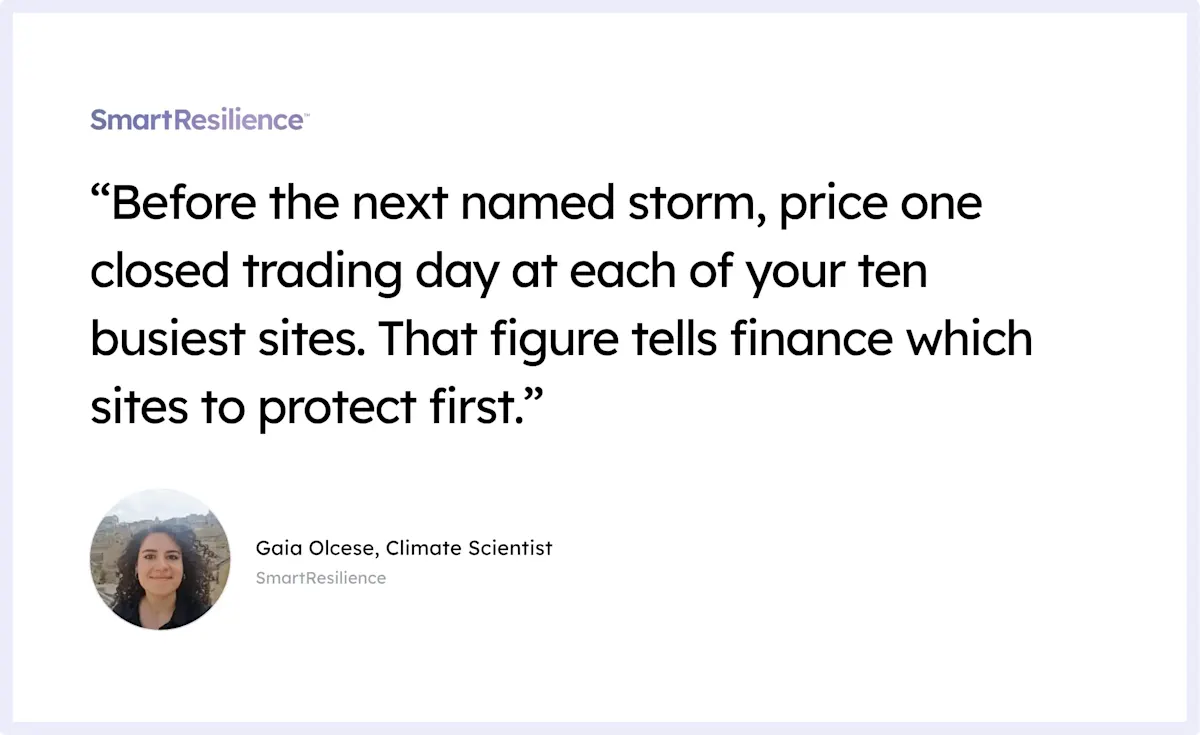
Closure days: Every day the doors stay shut, priced at that site's typical trading for the season.
Lost covers and room nights: Cancelled bookings, events and reservations, including those lost on the days either side of a closure.
Spoiled and condemned stock: Kegs, food and anything in a flooded cellar that cannot be sold after the water recedes.
Recovery costs: Cellar cleaning, equipment checks and any temporary staffing needed before the site reopens.
How do you turn the assessment into an adaptation plan and evidence for an insurance renewal?
Turning the assessment into a plan means fixing the sites that cost the most first, using the measures each building is allowed to have, and writing down the figures so finance and your insurer can check them. The measures themselves are familiar: removable barriers, non-return valves, raised cellar equipment, shading and added cooling. What changes the order is the AAL and PML at each site, and whether consent rules a measure out.
What a renewal-ready evidence pack contains:
A ranked site list: Every site on one scale by AAL and PML, so the insurer sees which sites carry the estate's exposure.
Measures taken and planned: Each permitted measure with its estimated cost, its expected return and its installation date.
The cost of doing nothing: Any trading loss that would sit above the business interruption limit, stated per site.
Supplier and menu contingencies: A second supplier or a flexible menu for weather-exposed lines, recorded as part of continuity planning.
A review date: A fixed point to revisit the figures, such as each insurance renewal or the annual budget cycle, so the plan stays current.
How SmartResilience helps you quantify physical climate risk across a hospitality estate
SmartResilience helps you quantify physical climate risk across a hospitality estate by putting a financial figure on the flood exposure of every pub, hotel and restaurant, ranking adaptation measures by return and warning site teams before an event arrives. SmartResilience Climate Assessments keep that view live and continuously updated, working alongside your operations, property and finance teams:
A financial figure per site for flood exposure: The platform reports an average annual loss and a probable maximum loss for every site, so a capital request carries a number.
Adaptation measures ranked by return: Your team sees which measures pay back and over what period, with the methodology and data lineage behind every figure ready for a renewal conversation.
Site-specific early warning with runbooks: Alerts reach facilities and site teams by SMS, email and dashboard, and every alert and response is logged as an evidence trail for insurers.
Sainsbury's runs early warning across 1,000+ sites. When Storm Franklin reached a town in February 2022 where a store had lost six weeks of trading to Storm Eva in 2015, the team had 12 hours' warning, the store was operational the next day and an estimated £3m loss was avoided.
SmartResilience
See SmartResilience in action
Book a free demo tailored to your organisation and assets.
Book a free demoWhat should a hospitality operator do next?
A hospitality operator has either had a weather event and wants to avoid the next one, or has been lucky so far and wants to stay that way. The next wet bank holiday or flooded cellar will land as one of two things: an expensed surprise at site level, or a costed line in a plan finance already approved. The deciding factor is whether the assessment behind it costs trading as well as buildings.
FAQs
What are the steps in a physical climate risk assessment for a hospitality business? The five steps are hazard identification, exposure and vulnerability mapping, the survey decision, financial quantification and adaptation planning. They run across every pub, hotel and restaurant in the estate rather than one site at a time.
Which climate hazards matter most for pubs and hotels? Surface water flooding at street level and in cellars, heat and wind usually carry the highest cost. Water stress matters most for hotels with high laundry and guest-room demand.
Do listed buildings need a different climate risk assessment? Listed buildings go through the same desktop assessment, but they usually need an on-site survey sooner. The survey confirms which flood measures need listed building consent and which suit the building's traditional construction.
How do you put a cost on lost trading from weather? Add expected closure days, lost covers and room nights, spoiled stock and recovery costs to the damage estimate for each site. This produces an average annual loss and a severe-event cost that include trading.
Who owns climate risk in a leased pub estate? Responsibility is often split. The property owner typically insures and repairs the building, while the operator or tenant covers contents and loss of trade, so each exposure needs a named owner.
Do you need to assess every site, or can you sample the estate? Every site needs at least a desktop pass, since exposure can differ sharply between neighbouring venues. Sampling works only for choosing which flagged sites need an on-site survey.